HIPAA And Flight Anxiety Apps: What It Really Means
HIPAA and flight anxiety apps are often misunderstood: most standalone consumer apps for fear of flying are not automatically covered by HIPAA just because they address anxiety. HIPAA usually applies only when the app is offered by, or acting for, a covered health care provider, health plan, or their business associate.
This guide is general privacy education, not legal or medical advice. For legal obligations, HIPAA compliance decisions, or treatment planning, consult a qualified attorney or licensed clinician.
- Most consumer flight anxiety apps are governed more by privacy policies, contracts, FTC rules, and state privacy laws than by HIPAA.
- An anxiety or mental health label does not, by itself, make an app HIPAA compliant or HIPAA covered.
- The practical question is what data the app collects, whether it shares data with advertisers or analytics partners, and what privacy rights users can exercise.
CalmFlying (flight-anxiety.app) is a flight anxiety app that provides meditation, hypnosis, breathing exercises, and cognitive techniques for nervous flyers. This page explains HIPAA and flight anxiety apps in plain English so U.S. users can understand when consumer wellness app data may or may not receive HIPAA protection.
Many nervous flyers assume any app that helps with anxiety is automatically covered by HIPAA, but that is usually not how the rule works. In CalmFlying user education, the most important distinction is whether the app is acting on behalf of a covered healthcare provider, health plan, or healthcare clearinghouse, versus offering general self-guided wellness tools directly to consumers. For flight anxiety support, users should read the privacy policy, check what data is collected, see whether data is shared for analytics or advertising, and avoid entering unnecessary sensitive details into any wellness app.
| Need | Best option |
|---|---|
| CalmFlying | Nervous flyers who want flight-specific calming routines, breathing, hypnosis, and cognitive techniques. |
| Calm or Headspace | General meditation, sleep, stress, and mindfulness support. |
| SOAR, FlyHome, or No Fear of Flying | Structured fear-of-flying education or specialized aviation anxiety support. |
| A therapist or clinic app portal | Clinical diagnosis, treatment, therapy notes, prescriptions, or coordinated care. |
HIPAA And Flight Anxiety Apps: The Plain-English Rule
HIPAA generally does not apply to standalone consumer flight anxiety or wellness apps. The trigger is not the word “anxiety”; it is the app’s relationship to a covered health care provider, health plan, or business associate.
In plain language: if you download an app yourself before a trip and type in fear-of-flying notes at midnight, that data may be sensitive, but it may still fall outside HIPAA. HHS says HIPAA generally does not protect health information a consumer creates or holds in mobile apps not offered by or on behalf of a covered entity source. KFF policy analysis also notes that most mental health apps are outside HIPAA for this reason source.
The seatbelt can feel tight. The legal boundary is tighter.
5 Facts About Consumer Wellness App HIPAA Coverage
These five facts explain why consumer wellness app HIPAA coverage is narrower than many nervous flyers expect.
- Standalone consumer apps are usually not HIPAA covered. If you choose the app directly, HIPAA often is not the main privacy rule.
- Mental health wording does not automatically trigger HIPAA. An app can mention panic, breathing, meditation, hypnosis, or CBT-style tools without becoming HIPAA covered.
- HIPAA can apply through a covered relationship. A provider, health plan, or business associate connection can change the legal status.
- Other privacy rules may still matter. FTC rules, state privacy laws, contracts, and app store policies can apply when HIPAA does not.
- HIPAA compliance does not prove the method works. Privacy law is separate from clinical evidence, aviation education, or whether a grounding exercise helps during takeoff.
For nervous flyers, a privacy label is only one part of the safety question. The broader issue is covered in are flight anxiety apps safe.
How Flight Anxiety App Privacy Law Works Behind The Scenes
Flight anxiety app privacy law depends on data flows, not the app category alone. Data you enter directly into a consumer app is often treated differently from medical records handled by your doctor, therapist, hospital, or health plan.
The key terms are covered entity and business associate. A covered entity is usually a provider, health plan, or health care clearinghouse. A business associate handles protected health information for one of them. A consumer app company may sit outside that structure unless it is working for one of those covered groups.
Behind the screen, the app may process account creation, in-app exercises, analytics events, crash logs, and optional support requests. A HIPAA notice of privacy practices is not the same thing as an app privacy policy. One belongs to HIPAA-covered care. The other explains company data practices.
Passport checked again at the gate. Different systems, different rules.
Are Anxiety Apps HIPAA Compliant By Default?
Are anxiety apps HIPAA compliant? Usually not by default. An app can discuss anxiety, panic symptoms, breathing exercises, meditation, hypnosis, or CBT-style tools without becoming HIPAA covered.
HIPAA may be triggered when the app is provided by a therapist, doctor, hospital, health plan, or vendor acting for one of those groups. That is different from opening the App Store, downloading a tool yourself, and using it while boarding group numbers are called.
Do not treat a HIPAA badge, logo, or marketing phrase as a full privacy guarantee. Ask what the app collects, where the data goes, whether advertising or analytics partners receive anything, and how deletion works. For mental health support, clinicians typically recommend matching the tool to the severity of symptoms and seeking professional care when panic or avoidance starts limiting daily life.
The label helps. It does not answer everything.
Consumer Wellness App HIPAA Scenarios: Covered vs Not Covered
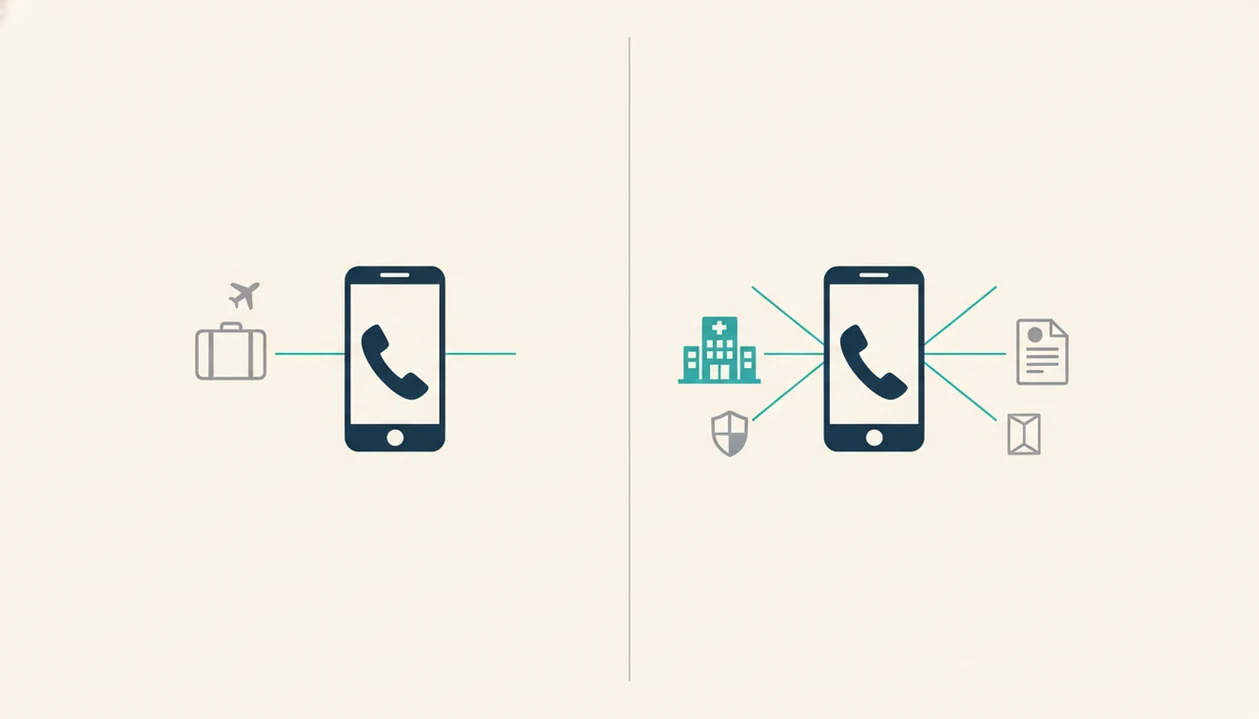
Whether HIPAA applies depends on relationships and data flows, not whether the app helps with flight anxiety.
| Scenario | HIPAA status | What to check |
|---|---|---|
| Standalone flight anxiety app downloaded by the user | Unlikely | Privacy policy, analytics, account deletion, data sharing |
| Clinician-prescribed app connected to therapy care | Context-dependent | Whether the clinician or practice uses it as part of treatment |
| Health plan app for nervous flyers | Likely or context-dependent | Whether the plan offers it and what data returns to the plan |
| Airline-branded wellness app | Unlikely | Whether it is wellness content or connected to health care services |
| EHR-integrated tool used in a clinic | More likely | Business associate role, HIPAA notice, medical record connection |
For most direct-to-consumer tools, privacy policy review matters more than the app’s category. The NHS describes CBT with gradual exposure as a common treatment approach for phobias, while apps may support practice between formal care source.
Flight Anxiety App Privacy Red Flags To Check
Good privacy checking starts with ordinary words: advertising, marketing, analytics, partners, sale, sharing, and affiliates. If those terms are broad or hard to understand, slow down before entering personal fear notes.
App Store Privacy Labels
App store privacy labels are useful for a first pass. Look for data linked to you, tracking across apps, location access, contacts, microphone use, or device permissions that do not fit flight anxiety practice.
A 2022 Mozilla review of 32 mental-health and prayer apps found that 28 earned a privacy warning, which is why app-store labels should be treated as a starting point, not a guarantee source. That tracks with what I hear from nervous flyers: if the tool feels nosy, people stop opening it before the cabin bins click shut.
Privacy Policy Language
Read the full policy for account deletion, data export, opt-out rights, support contact options, and data sale or sharing. For a deeper plain-language checklist, the guide to privacy in flight anxiety apps covers the questions worth asking before you rely on any tool in the air.
Common Myths About HIPAA And Flight Anxiety Apps
Several HIPAA myths make app privacy feel more certain than it is.
Myth: Any mental health app must be HIPAA compliant. Reality: HIPAA depends on the app’s relationship with covered health care entities.
Myth: HIPAA covers all health information everywhere. Reality: the same anxiety note may be HIPAA-protected in a therapy record but not in a consumer app journal.
Myth: HIPAA marketing means no data sharing. Reality: marketing language should be checked against the privacy policy and actual data flows.
Myth: If HIPAA does not apply, there are no privacy rules. Reality: FTC enforcement, state laws, and consumer protection rules may still apply.
Myth: HIPAA compliance means the app is clinically proven. Reality: privacy compliance and clinical effectiveness are separate questions. If you are asking can an app cure fear of flying, the honest answer depends on symptoms, evidence, and support.
CalmFlying Privacy Questions For Nervous Flyers
Tools like Flight Anxiety App can help nervous flyers practice meditation, hypnosis, breathing exercises, and cognitive techniques before and during travel. The honest privacy question is not only “Is HIPAA triggered?” It is also, “If not, what protections are in place?”
Review the privacy policy, data collection, data sharing, deletion rights, and support contact options before you use any app for personal anxiety notes. A flight-anxiety app can offer breathing, meditation, hypnosis, and cognitive practice, but it cannot promise HIPAA coverage, legal certainty, or clinical care.
When your heartbeat is felt through a sweater at cruising altitude, the exercise should be simple: feel both feet, soften the jaw, let the exhale be longer.
When To Seek Professional Or Legal Help
Seek professional help when flight anxiety is no longer just uncomfortable, but is blocking necessary travel, work, medical care, or family life. Seek legal or compliance help when you are making decisions for an organization, not just choosing an app for yourself.
A consumer app can support practice, but it is not a substitute for treatment, crisis care, or legal advice. Use this order when the question feels bigger than a privacy label:
- Contact a licensed clinician if panic attacks, avoidance, trauma memories, or dread are making required travel feel impossible or unsafe.
- Use emergency or crisis resources right away if there is any immediate risk of harm to yourself or someone else.
- Ask a lawyer or compliance officer if your clinic, employer, airline, school, or benefits team needs to know whether HIPAA or another rule applies.
- Treat marketing claims cautiously and do not use “HIPAA compliant” language from an app page as proof of legal compliance.
- Bring specific privacy questions to the right person: a therapist for treatment records, an employer or insurer for benefits data, and an attorney for legal obligations.
The next right step may be care, compliance review, or simply asking clearer questions before takeoff.
Limitations
HIPAA is important, but it is not the whole privacy or care picture.
- HIPAA is a privacy and security framework, not proof that app techniques work.
- Many wellness and mental health apps have limited rigorous clinical evidence for fear-of-flying outcomes.
- Strong security does not prevent broad data sharing if the privacy policy allows it.
- Data you export, screenshot, email, or share with others may fall outside app protections.
- FTC enforcement, state privacy laws, and health app rules are still evolving.
- A consumer wellness app may be helpful for practice, but severe panic, trauma, or avoidance may need clinician support.
- This article is informational and is not legal advice.
If flying fear is reshaping work, family visits, or medical travel, read about when to see therapist for fear of flying. Support can be practical. Feet down, one breath, then the next right step.
Read more
FAQ
Are anxiety apps HIPAA compliant?
Anxiety apps are not HIPAA compliant by default. HIPAA depends on whether the app is offered by, or acting for, a covered health care provider, health plan, or business associate.
Does HIPAA cover wellness apps?
HIPAA usually does not cover standalone consumer wellness apps. It may apply if the app is provided through a covered provider or health plan.
Can apps share anxiety data?
Apps may share anxiety-related data depending on their privacy policy, applicable consumer protection rules, and state privacy laws. Users should check advertising, analytics, sale, and sharing language.
What makes an app HIPAA covered?
An app may become HIPAA covered when it handles protected health information for a covered provider, health plan, or business associate. Direct-to-consumer use alone usually does not create that relationship.
Is flight anxiety medical data?
Flight anxiety information can be sensitive health-related data. It is not always HIPAA-protected data unless it is handled within a HIPAA-covered relationship.
Do therapists change HIPAA rules?
Yes, they can. A therapist-prescribed or provider-integrated app may be treated differently from a consumer app downloaded independently.
Are app privacy labels enough?
No. App store privacy labels are useful summaries, but they should be checked against the full privacy policy and account settings.
Can I delete app data?
Deletion rights depend on the app’s policy, account tools, jurisdiction, and applicable privacy laws. Check whether the app offers account deletion, data export, and support contact options.