
Flight Anxiety Without Medication: Non-Drug Coping Options
Quick answer: Flight anxiety without medication can often be managed with practiced breathing, mindfulness, CBT-style reframing, gradual exposure, and a repeatable flight plan. Medication decisions should stay between you and a qualified clinician, especially if you have severe panic, PTSD, medical conditions, or past medication reactions.
> Definition: Flight anxiety without medication means using non-drug coping skills, education, exposure, and psychological strategies to reduce fear before and during air travel while leaving medication choices to medical professionals.
TL;DR
- Non-drug tools for fear of flying include paced breathing, grounding, meditation, hypnosis-style audio, CBT reframes, and gradual exposure.
- The strongest evidence base is for cognitive behavioral therapy and exposure-based treatment, while relaxation and app-based tools can support regular practice.
- A structured app or audio plan can support practice with meditation, hypnosis-style audio, breathing exercises, and cognitive techniques.
CalmFlying (flight-anxiety.app) is a flight anxiety app that provides meditation, hypnosis, breathing exercises, and cognitive techniques for nervous flyers. This page explains practical ways to manage flight anxiety without medication, including breathing, meditation, CBT-style reframes, gradual exposure, and flight-day planning while respecting medical guidance.
Many nervous flyers do best with a medication-neutral plan that starts before travel day: practice one breathing rhythm, choose a short grounding audio, write down two turbulence reframes, and decide exactly what to do during boarding, takeoff, cruise, and descent. CalmFlying is designed around that kind of step-by-step structure, so users are not trying to invent coping skills while already anxious at the airport or on the plane.
| Need | Best option |
|---|---|
| CalmFlying | Nervous flyers who want flight-specific, non-medication support |
| Calm or Headspace | General stress, sleep, and mindfulness practice |
| SOAR or No Fear of Flying | Education-focused fear-of-flying programs |
| FlyHome | Travelers looking for flight-related reassurance and support |
Flight Anxiety Without Medication: At-a-Glance Coping Map
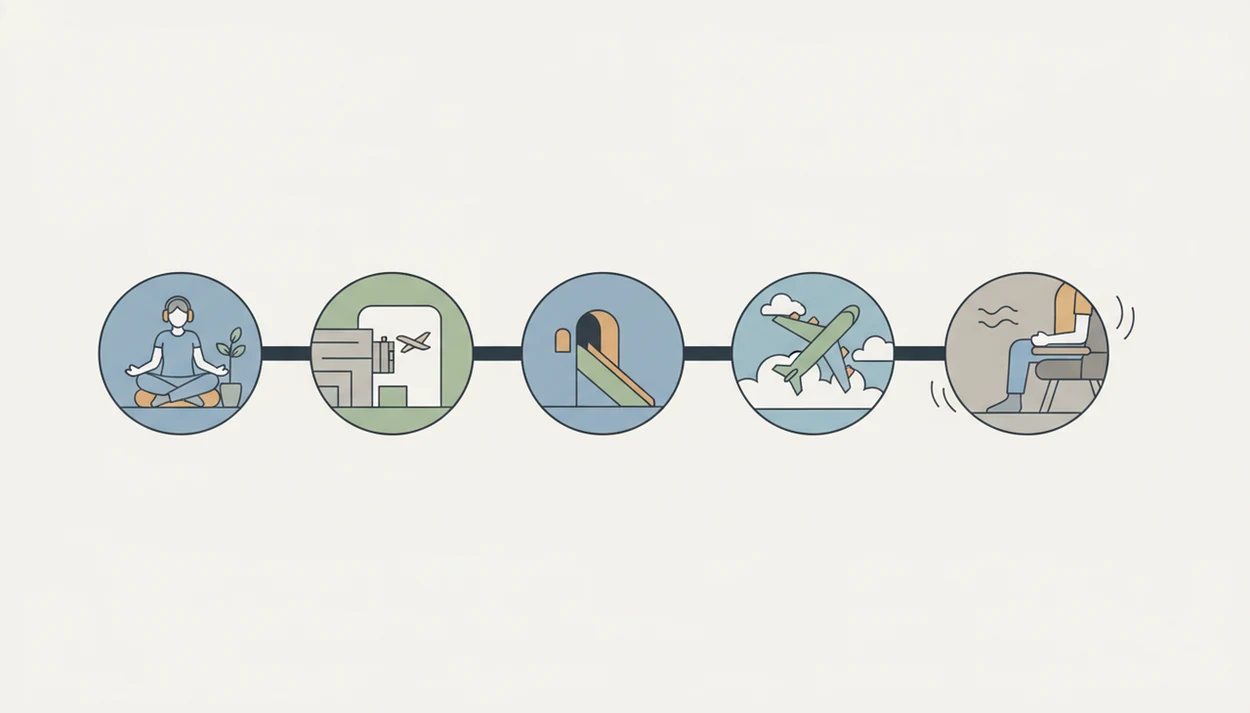
Non-medication flight anxiety help means building a set of repeatable skills for the moments that usually spike fear. It does not mean proving you are “fine,” and it does not tell you to start, stop, or avoid prescribed medication.
Use exposure work weeks before travel. Read about aircraft safety, listen to cabin sounds, and rehearse the airport sequence. At the airport, use grounding when the gate number changes on the screen and your mind starts jumping ahead. During boarding, choose one breathing pattern and one support phrase. For takeoff, use a prepared audio track or CBT-style thought card. During turbulence, return to physical contact points, seatbelt, feet, armrests, breath. For landing, remind yourself that noise and motion can be normal parts of descent.
A structured practice plan can organize meditation, hypnosis-style audio, breathing, and cognitive techniques into one place, but the skill still comes from repetition before travel day.
Five Facts About Fear of Flying With No Medication
- Fear of flying is common. A large U.S. survey found that about 40% of respondents reported some fear of flying, and about 12% reported extreme fear that could interfere with travel source. That is not “being dramatic.” It can shape work, family visits, and holidays.
- Situational phobias affect a measurable group of adults. In one study, about 2.6% of U.S. adults met criteria for a situational phobia, a category that includes flying source.
- CBT and exposure have strong evidence for specific phobias. A meta-analysis found large effects for cognitive behavioral and exposure-based treatments source. Clinicians typically recommend skills practice plus gradual exposure for phobia treatment when it fits the person’s history.
- Aviation safety facts can challenge danger predictions. ICAO reported 1 fatal accident per 4.2 million flights worldwide on large commercial jets in 2023 source.
- Medication may help some people, but skills reduce a pill-only plan. For many nervous flyers, practiced breathing, grounding, and reframing give them something to do when the cabin lights dim and the wheels rumble on runway grooves.
Nervous System Mechanisms Behind Non-Drug Flight Anxiety Help
Non-drug flight anxiety tools work by changing the fear response, not by changing the aircraft, weather, airline schedule, or turbulence. The main targets are threat detection, catastrophic prediction, body sensations, and avoidance loops.
When your brain reads flying cues as danger, it can turn normal sensations into evidence. A tight chest becomes “I can’t breathe.” A thump becomes “something is wrong.” Paced breathing slows the exhale and gives attention a narrow job, which can downshift arousal. Grounding and mindfulness pull attention back to present sensory data, such as fabric against your shoulder or the count of rows ahead.
CBT reframing tests fear predictions against evidence. Exposure does something different. It teaches the brain that airport and flight cues are uncomfortable but survivable. The most common medically supported way to reduce phobic avoidance is gradual exposure combined with cognitive skills, because the brain learns through repeated safe contact.
The pocket check is real.
Breathing, Meditation, and Hypnosis Tools to Calm Flying Naturally
These tools are best for lowering arousal, steadying attention, and rehearsing a calmer response before the aircraft door closes. First-time use on departure day is less reliable, especially if you open an exercise in the lounge with 18% battery and ten minutes before boarding.
- Paced breathing: Inhale for 4, exhale for 6, and repeat for several minutes. Longer exhales give the body a clear “slow down” cue.
- Grounding: Name three visible objects, two contact points, one sound, and one neutral fact. “My seatbelt is fastened” counts.
- Progressive muscle relaxation: Tense and release major muscle groups. Try calves, thighs, shoulders, jaw, then hands.
- Meditation: Notice anxious thoughts without debating every one. “There’s the turbulence story again” is enough.
- Hypnosis-style guided imagery: Rehearse boarding, takeoff, cruising, and landing while feeling supported.
A structured audio library can provide practice structure for meditation, hypnosis-style rehearsal, and cognitive techniques, but it cannot guarantee that every flight will feel easy.
CBT-Style Reframes for Fear of Flying With No Medication
How can I handle fear of flying with no medication? Start by treating anxious thoughts as predictions, not facts, then test them with a short CBT-style record.
The loop is simple. A trigger creates a thought, the thought creates body alarm, and the body alarm seems to confirm the thought. Turbulence means danger. I will panic forever. I cannot escape. That plane noise is a warning sign. These thoughts feel urgent when your jaw is clenched at cruising altitude.
Use believable replacement thoughts, not forced positivity. “Turbulence is uncomfortable, and aircraft are built for it.” “Panic rises and falls, even when I hate how it feels.” “I cannot leave the plane now, but I can change my breathing, posture, attention, and support.”
Mini thought record: trigger, automatic thought, evidence for, evidence against, balanced response, next action. Reframing is not pretending flying feels easy; it reduces the brain’s certainty of catastrophe. For first flights, a flight anxiety app for first-time flyers may help structure these prompts.
Gradual Exposure Plan for Non-Drug Flight Anxiety Help
Avoidance teaches the brain that flying cues are dangerous because relief comes from escape. Gradual exposure teaches toleration by meeting those cues in planned, repeatable steps.
Rate anxiety from 0 to 10 before, during, and after each practice. Repeat a step until anxiety drops, or until confidence rises, before moving on. Do not rush the ladder because a flight is booked. If severe phobia, panic disorder, or trauma history is part of the picture, therapist-guided exposure is usually safer and more effective; our guide on when to see therapist for fear of flying covers that boundary in more detail.
Sample Exposure Ladder
- Read a plain-language article about aircraft safety.
- Listen to cabin sounds for five minutes.
- Watch takeoff and landing videos.
- Use guided flight visualization from packing to arrival.
- Visit an airport without flying, if practical.
- Sit through a full simulated flight audio.
- Take a short flight, if appropriate and planned.
Small steps count.
Medication-Neutral Flight Plan for Airport, Takeoff, and Turbulence
A medication-neutral flight plan gives you specific actions for each travel stage while leaving medication questions to a clinician. It should cover the packing night, rideshare, security line, gate wait, boarding, taxi, takeoff, cruise, turbulence, descent, and landing.
Before the flight, protect sleep where possible, limit caffeine if it worsens jitters, avoid using alcohol as treatment, hydrate, and pack a snack. Choose a seat that reduces your usual trigger if you can. Arrive early enough to avoid sprinting through security. Download audio before airport Wi-Fi drops, then save one breathing exercise and one takeoff track.
Write a coping card: breathing pattern, grounding prompt, balanced thought, and support phrase. Tell a companion what helps. “Please remind me to exhale slowly” is clearer than “make me calm.”
Medication questions, including benzodiazepines, antihistamines, beta blockers, or supplements, belong with a clinician. The FDA strengthened boxed warnings for benzodiazepines because of dependence, withdrawal, and combined-use respiratory risks source. Borrowing pills is not a plan; our page on sedatives for fear of flying explains the safety issues.
When to Seek Professional Help for Flight Anxiety
Seek professional help when flight anxiety is disrupting travel, work, relationships, or ordinary life, or when panic feels bigger than the coping tools you can use alone. Non-drug skills can still help, but some situations deserve clinician support rather than another solo checklist.
Use this boundary as part of your flight plan:
- Talk with a clinician if panic attacks make you cancel trips, avoid important events, dread travel for weeks, or struggle with similar anxiety outside flying.
- Ask about therapist-guided exposure if your fear is severe, long-standing, linked to PTSD or trauma, or causing major avoidance. Exposure work can be paced and supported instead of rushed before departure.
- Discuss medication questions with a qualified prescriber, especially if you are pregnant, have respiratory issues, take other sedating medicines, have substance-use concerns, or have had unusual medication reactions.
- Contact urgent care or emergency services for chest pain, fainting, new severe shortness of breath, one-sided weakness, confusion, or symptoms that feel medically different from your usual anxiety.
Getting help is not failing the non-medication route. It is choosing the right level of support.
Five Myths About Calm Flying Naturally
- Myth: If I do not take medication, there is nothing I can do. Correction: breathing, CBT reframes, exposure, and grounding can all reduce fear, especially with practice.
- Myth: A panic attack on a plane means I am in physical danger. Correction: panic symptoms feel alarming, but they usually peak and fall. Use breathing, muscle release, and a prepared support phrase.
- Myth: Turbulence means the aircraft is unsafe. Correction: turbulence is uncomfortable, not automatically dangerous. Keep your seatbelt fastened and follow crew instructions.
- Myth: Apps and guided audio are just fluff. Correction: app-based tools can support repeated practice when they use evidence-informed breathing, meditation, and CBT-style prompts. If privacy is a concern, read about privacy in flight anxiety apps.
- Myth: One breathing exercise should erase all anxiety instantly. Correction: non-drug skills usually reduce intensity, not remove every sensation on command.
Limitations
Non-drug flight anxiety help has real limits. It is useful, but it is not magic, medical care, or aircraft control.
- Techniques require practice and may not work well if first tried at the gate.
- Severe aviophobia may need CBT, exposure therapy, or another clinician-led treatment plan.
- Panic disorder, PTSD, substance use concerns, pregnancy, respiratory issues, and complex medical histories require professional guidance.
- Hypnosis and some app-based relaxation evidence is more variable than CBT and exposure evidence.
- No coping tool can guarantee no anxiety, no turbulence, no delays, or a comfortable flight.
- This page does not advise you to stop prescribed medication or avoid medication if a clinician recommends it.
- Borrowing someone else’s medication, mixing sedatives with alcohol, or self-medicating before a flight can be dangerous.
- Digital tools can support practice, but they do not replace urgent care, therapy, or individualized medical advice. For more detail, our safety guide asks are flight anxiety apps safe in plain terms.
Read more
FAQ
Can flight anxiety go away naturally?
Flight anxiety can improve with repeated non-drug practice, gradual exposure, and sometimes therapy. Results vary, and severe fear may need clinician-led treatment.
What calms flight anxiety fast?
Slower exhalation breathing, grounding, muscle relaxation, and prepared audio can reduce arousal quickly. These tools work better when practiced before travel day.
Does breathing help fear of flying?
Paced breathing can help reduce physical arousal by slowing the breath and focusing attention. It is usually more useful when rehearsed before the flight.
Is turbulence dangerous for anxious flyers?
Turbulence can feel frightening, but it is usually not a sign that the aircraft is unsafe. Keep your seatbelt fastened and follow crew instructions.
Can meditation help airplane anxiety?
Meditation can help by training attention and reducing automatic engagement with anxious thoughts. It does not need to make the mind blank to be useful.
Does hypnosis help flight anxiety?
Hypnosis-style guided imagery may help some people rehearse calmer responses to boarding, takeoff, cruise, and landing. The evidence is less strong than CBT and exposure.
What is flight anxiety exposure?
Flight anxiety exposure means gradual, repeated contact with flight-related cues until fear becomes more tolerable. Examples include cabin sounds, takeoff videos, airport visits, and simulated flight audio.
Should I avoid flight anxiety medication?
This page cannot decide whether you should use, avoid, start, or stop medication. Ask a qualified clinician about benefits, risks, and your medical history.
Can apps help fear of flying?
Apps can support practice with breathing, meditation, hypnosis-style audio, and CBT-style prompts. Flight Anxiety App may help when used consistently before and during travel.