
What causes turbulence on a plane
By the FlyCalm.me team · Updated
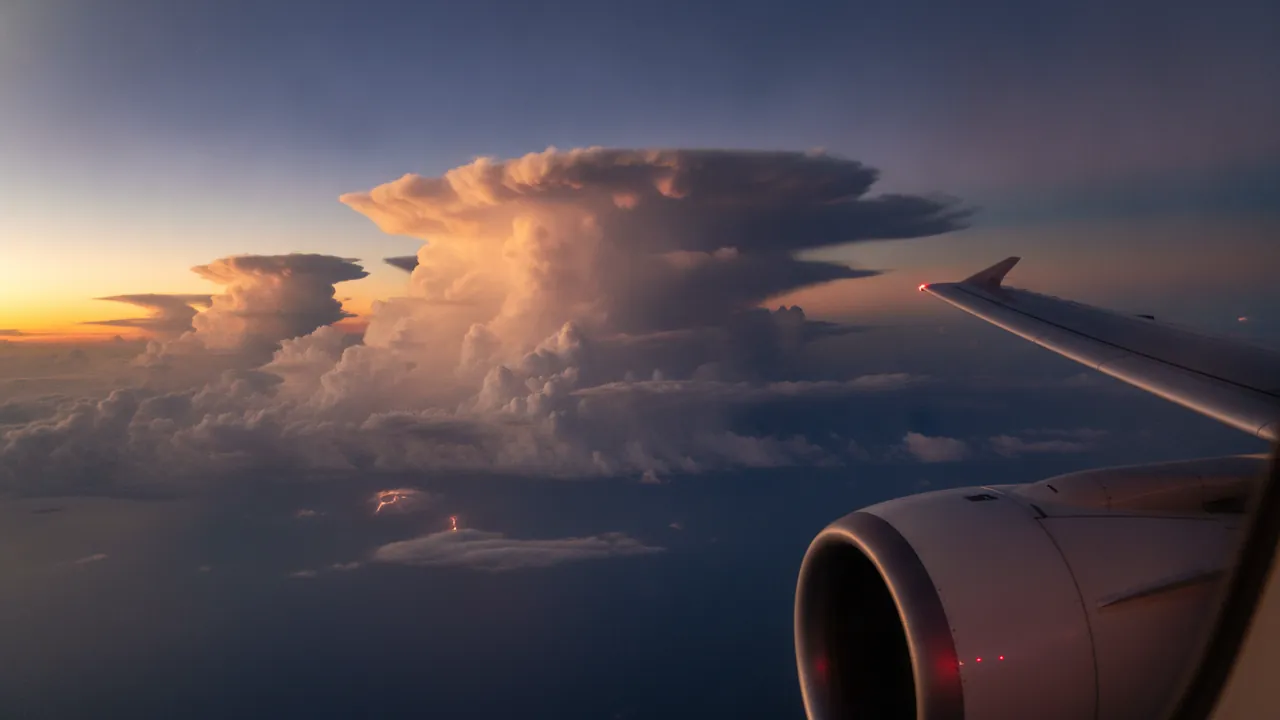
What causes turbulence on a plane? Moving air. Turbulence is irregular motion of the aircraft caused by rapid changes in air speed, direction or vertical flow, and the main triggers are storms, wind shear near the jet stream, wind pushed over mountains and the swirling wake behind other aircraft. It is the sky behaving like water, not a fault in the plane.
Why the air is never still
Think of a boat on a river. Where the current is smooth the ride is smooth, and where it hits rocks or meets another current you feel it. The atmosphere does the same at a much larger scale, and a plane at 35,000 feet is moving through layers of air that travel at different speeds and in different directions. Each time the wing passes from one pocket to another, the lift changes for a moment, and you feel a bump.
The six main causes of turbulence
Thunderstorms and rising air
Convective turbulence comes from warm air rising and cooler air sinking, as in cumulus clouds and storms. It is strongest near thunderstorms. Pilots see these on radar and plan around them, and aircraft do not normally try to fly through a thunderstorm.
Clear-air turbulence
This one happens in cloudless sky, usually near the jet stream, where air speeds change sharply from one level to another. It gives little or no visual warning, and weather radar does not detect it. It is the reason pilots ask you to keep your seat belt on when the sign is off, and the reason it is the most talked about type among nervous flyers.
Wind over mountains
When strong wind crosses a mountain range, the air ripples downwind like water over a rock, a pattern called a mountain wave. It can reach cruising altitude and extend a long way from the peaks, and the lower layers can be rough and rotating. Flights over the Rockies, the Andes or the Alps can feel it.
Wake from other aircraft
Every plane leaves a pair of swirling vortices behind its wings, strongest from heavy, slow aircraft. The vortices sink and spread. Air traffic control spaces aircraft to avoid flying into them, but a short jolt near an airport is possible.
Jet-stream shear
Where the jet stream's fast ribbon of air meets slower air beside it, the speed changes abruptly over a short distance. That wind shear makes the air unstable and is the biggest single source of clear-air turbulence.
Low-level wind and terrain
Near the ground, wind pushed around buildings, hills and trees causes mechanical turbulence. This is why a landing in a strong crosswind feels bumpier than the cruise, even in clear weather.
How strong turbulence gets
The FAA rates turbulence by what the aircraft does, not by how it feels. In light turbulence the plane makes slight, erratic changes in altitude or attitude. In moderate it makes larger changes but stays under positive control. Severe means large, abrupt changes where the plane may be briefly out of control, and extreme means it is violently tossed and nearly impossible to control. The last two are rare, and they are the ones that reach the news. The question of whether they can hurt anyone is covered in is turbulence dangerous.
Where on the plane turbulence feels worst
The ride is usually gentlest near the plane's center of gravity, which is close to the wings. It gets lively toward the nose and especially the tail, because those spots are farther from the point the aircraft pivots around, so small movements swing wider there. The back of the cabin can feel more bouncing and swaying than a seat over the wing. Exact sensations depend on the aircraft type and which way it is pitching or rolling, so there is no seat that is calm in every case. If you are nervous, a seat over the wing is a reasonable bet, as first flight anxiety tips also suggest.
Is turbulence getting worse over time
Research at the University of Reading says clear-air turbulence is increasing as the climate warms. A 2023 study found moderate clear-air turbulence rises by about 14% in summer and autumn and 9% in winter and spring for each 1 degree Celsius of global warming. Earlier work projected 40% to 170% more clear-air turbulence over the North Atlantic, depending on severity, if carbon dioxide doubles. Another analysis found light clear-air turbulence over a North Atlantic location up 17% and severe up 55% between 1979 and 2020.
These are model-based and regional figures, not a promise that every flight gets rougher. Even so, it is a good reason for airlines to improve forecasts and for you to keep your belt on.
How pilots plan around turbulence
- They study weather forecasts, satellite data, radar and turbulence reports from other aircraft before and during the flight.
- They route around storms and ask air traffic control for a different altitude when smoother air is likely.
- They slow to the recommended turbulence speed in rougher air, which reduces loads on the aircraft.
- They switch on the seat belt sign and ask the cabin crew to sit down when it looks bumpy ahead.
Pilots cannot see every patch of clear-air turbulence in advance, so avoidance is a matter of probability, not a guarantee. That is why the best protection is not a forecast but a fastened belt.
When knowing the cause of turbulence does not help
Understanding the cause makes the bumps feel less like a threat for some people and does nothing for others. If your body reacts anyway, you need a plan rather than another fact. What to do during turbulence anxiety has the steps, and the fear of flying app page describes FlyCalm.me, which lists simulated turbulence training and aviation explanations in its App Store description.
Sources: FAA turbulence definitions and pilot guidance, the FAA Aviation Weather Handbook, and University of Reading research on clear-air turbulence, checked on 2026-11-22.
Frequently asked questions
Do clouds cause turbulence?
Some do. Cumulus and storm clouds mark rising and sinking air, so flying through or close to them is bumpy, and pilots route around the worst. Thin, flat clouds usually mean smooth air. Clear sky can be rough too, because clear-air turbulence leaves no cloud.
Can pilots see turbulence coming?
Often, but not always. Weather radar shows storms and rain, and forecasts and other pilots' reports flag likely rough areas. Clear-air turbulence does not show on radar, so crews rely on probability and keep the seat belt sign ready. Pilots may also ask for a different altitude when a report suggests smoother air.
Is turbulence getting worse because of climate change?
University of Reading studies project more clear-air turbulence as the planet warms, for example about 14% more moderate turbulence per degree Celsius in summer and autumn. These are regional model results, so any single flight may not feel a difference.
Is there a smoothest time of day to fly?
Early morning is often calmer, since the ground has not yet heated and fewer thermals and storms have formed. Afternoon and evening flights in warm weather meet more convective bumps. It is a tendency, not a guarantee. Checking a forecast helps some people, but it can also raise worry, so use it only if it calms you.
Why is it bumpier on landing than at cruise?
Near the ground the air is stirred by terrain, buildings and heating, which causes mechanical and thermal turbulence. The plane is also slower and flying lower, so the same gust is felt more. It is normal and well within limits.
What is the difference between light and severe turbulence?
Light turbulence is brief bumps that rock the plane slightly, while moderate turbulence moves unsecured items and makes walking hard. Severe turbulence throws the plane around and is rare. Crews report the level, and pilots use this information to avoid or leave rough air.
Does turbulence happen more over oceans or mountains?
Mountains create mountain waves and rotor air that cause turbulence, while oceans have fewer features but can still have storms and jet-stream shear. Where turbulence happens depends on the weather of the day more than on a single region. Forecasts show which routes look rough.