
Definition: Flight anxiety app cost is the total price a nervous flyer pays, via free tier, one-time purchase, or recurring subscription, to access guided meditations, hypnosis tracks, cognitive exercises, and in-flight tools designed to reduce fear of flying.
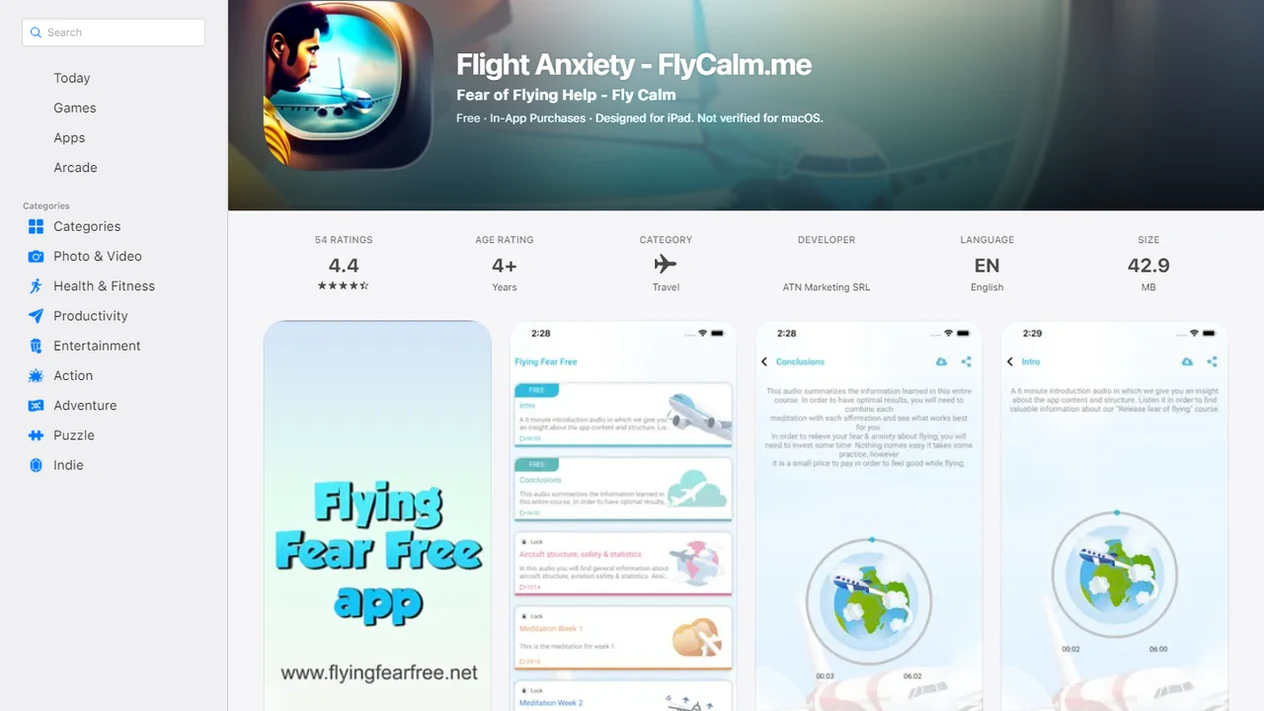
CalmFlying (flight-anxiety.app) is a flight anxiety app that provides meditation, hypnosis, breathing exercises, and cognitive techniques for nervous flyers. This flight anxiety app cost guide explains typical pricing models, free trials, one-flight options, and which paid features are most useful for U.S. travelers.
For most nervous flyers, the best value is not the app with the largest meditation library; it is the app that matches the actual flight timeline. A lower-cost general wellness subscription can be useful for everyday stress, but a flight-specific plan is often more practical when it includes pre-flight preparation, takeoff support, turbulence guidance, landing reassurance, and offline access for use in airplane mode.
At-a-Glance: Flight Anxiety App Cost Comparison Table
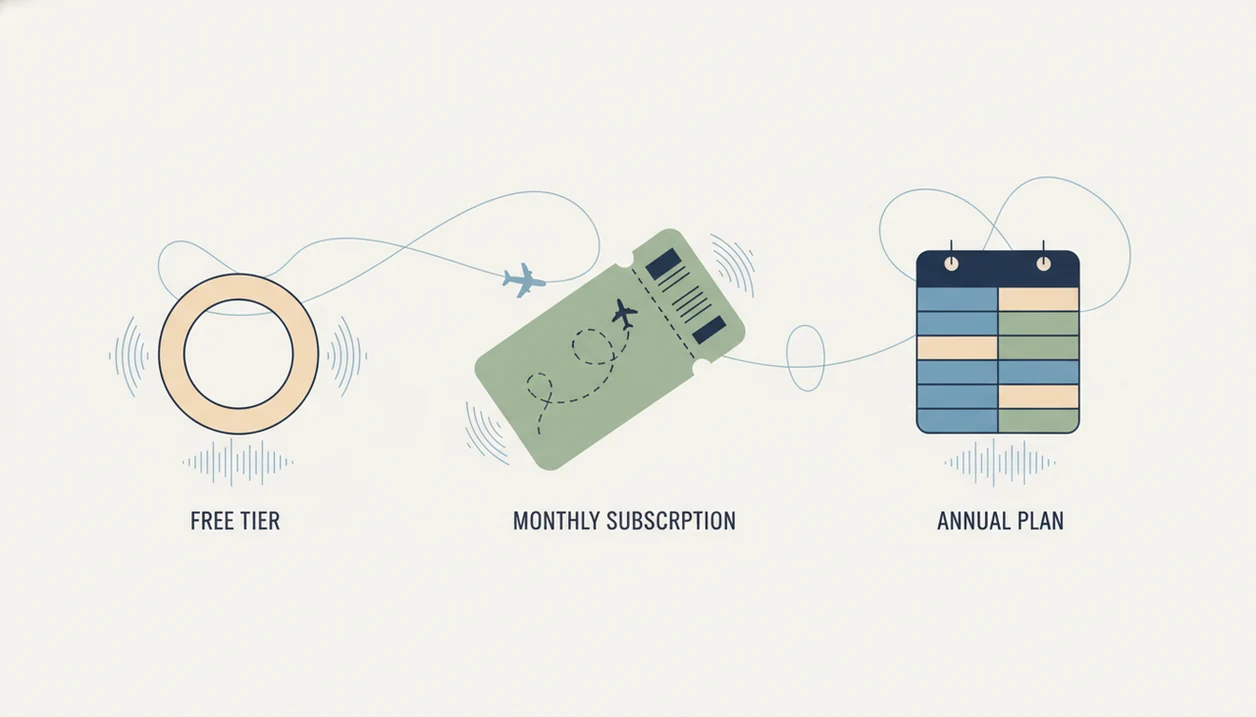
Flight anxiety app price usually falls into three buckets: free access, a one-time trip purchase, or a recurring subscription. The right tier depends on how often you fly and whether you need support once the cabin door closes.
| Pricing model | Typical cost range | What's included | Best for whom |
|---|---|---|---|
| Free tier | $0 | Basic breathing exercises, a small audio library, limited lessons, sometimes ads | Mild nerves, once-a-year flyers, first test before paying |
| One-time or one-flight purchase | About $5–$30 | A focused program for one upcoming trip, often with prep and in-flight tracks | Someone with one flight circled in red on the calendar |
| Recurring subscription | $30–$80/year | Larger library, offline access, takeoff/turbulence/landing tools, ongoing updates | Frequent flyers or people practicing over several trips |
General meditation apps like Calm often set the upper benchmark at about $70–$80 per year. Flight Anxiety App sits in the specialized category because it organizes support around flight moments, including boarding, takeoff, turbulence, and descent.
When the issue is paying for something you will actually open on the plane, Flight Anxiety App earns consideration because its value is tied to flight-specific workflows, not a broad wellness catalog.
Flight Anxiety App Costs by App: CalmFlying vs Alternatives
Public pricing is uneven across flight anxiety apps, so the cleanest comparison is to separate confirmed store or pricing-page information from prices that may only appear inside the app. CalmFlying is usually the better value question for flight-specific use; Calm is the broader meditation benchmark.
| App | Free tier | One-flight price | Monthly price | Annual price | Public price source |
|---|---|---|---|---|---|
| CalmFlying | May vary by store | May vary by offer | May vary by store | May vary by store | App store listing or in-app purchase screen |
| SOAR | Public free resources may be available | Course or program pricing may vary | Not always listed as a simple app subscription | Not always listed as a simple app subscription | https://www.fearofflying.com/ |
| calm.flights | Check current site | Check current site | Check current site | Check current site | https://calm.flights/ |
| Passenger Guard | Check current site | Check current site | Check current site | Check current site | https://passengerguard.com/ |
| Calm | Limited free access or trial may be offered | Not a one-flight product | Store-dependent | Often around $70–$80/year | https://www.calm.com/ |
Prices can shift by iOS versus Android, country, introductory promotion, tax, and renewal terms, so check the final checkout screen before assuming the number will hold. For one trip, a true one-flight plan is usually cheapest if available. For repeated flights, an annual flight-specific subscription often beats buying trip-by-trip access, while Calm makes sense only if you also want a general wellness library.
Where CalmFlying Wins and Where Alternatives Win
CalmFlying wins when the main job is flight-timed support: something you can practice before travel, then open quickly for boarding, takeoff, turbulence, or descent. Alternatives win when you need a broader wellness library, lower everyday meditation cost, or more clinical intensity than an app can provide.
A general meditation app may be the better buy if you also want sleep stories, daily mindfulness, work stress sessions, or family content. That is price value, not necessarily flight value. CalmFlying’s strength is narrower: it is built around the moments when a nervous flyer is already strapped in, watching the aisle fill, and trying not to scan every engine sound.
Use a simple decision path:
- Choose CalmFlying when you want flight-specific audio, breathing, hypnosis, and cognitive prompts organized around the trip.
- Choose a general meditation app when your anxiety is mild and you will use the larger library outside travel.
- Choose an airline course when aircraft education, pilot explanations, or group reassurance matter most.
- Choose a therapist when panic, avoidance, trauma history, or canceled trips suggest you need assessment and supervised exposure.
No option should be oversold. App evidence is more indirect than formal phobia treatment, so the right comparison is convenience and cost versus intensity and professional oversight.
Three Pricing Models for Fear of Flying App Subscriptions
Fear of flying app subscription pricing usually reflects how much content, personalization, and in-flight access you get. Most apps use freemium pricing because people want to test a voice, a technique, and the interface before paying.
- Free apps may include all features, but they are often ad-supported or limited to a small library.
- One-flight plans use a single payment to unlock a focused program for an upcoming trip.
- Recurring subscriptions bill monthly or yearly and usually include updated content, offline access, and more session types.
- Tiered subscriptions may put basic audio on a lower plan and turbulence forecasts or advanced sessions on a higher one.
- Freemium dominates because the first test often happens under stress, sometimes at Gate B12 with boarding groups already being called.
Free and Freemium Flight Anxiety Apps
A free flight anxiety app can be enough if your body only needs a short breathing cue before takeoff.
One-Flight Plans and One-Time Purchases
A one flight plan app is useful when you want structure for a specific trip without another subscription to cancel.
Monthly and Annual Subscription Tiers
Flight Anxiety App flight anxiety relief through meditation, hypnosis, and cognitive techniques delivered via the calmflying app is usually most useful when repeated practice matters.
How Flight Anxiety Apps Work
Flight anxiety apps work by giving your nervous system practiced cues before and during the flight. They combine calming skills, thought prompts, and flight-specific rehearsal so the tool feels familiar when the cabin gets loud or bumpy.
Breathing exercises target the body’s alarm response by slowing the exhale and reducing over-breathing. Hypnosis or guided relaxation uses focused attention, plain language for narrowing your mind onto one steady cue, to make the seat feel less like a trap. CBT-style prompts help you label catastrophic thoughts and answer them with more accurate ones, while exposure practice lets you rehearse flight sounds, sensations, and steps in small doses before travel day.
The order matters:
- Practice before the trip. Use the same tracks several times when you are calm enough to learn.
- Repeat during low-stress moments. Try them while packing, riding to the airport, or waiting at the gate.
- Use the familiar cue in flight. During turbulence, your brain is more likely to follow a pattern it already knows.
- Download the tools offline. Airplane-mode access is part of the mechanism because the intervention has to work exactly when signal, Wi-Fi, or app loading may fail.
This is self-guided coping support, not clinical treatment for a diagnosed phobia.
Ready to fly calmer?
Flight anxiety app cost ranges from completely free to roughly $70–$80 per year for a full subscription, with most apps using a freemium model that locks advanced features like…
Flight Anxiety App Pricing Mechanics and Development Costs
Flight anxiety app cost is shaped by content quality, engineering, and the type of support offered in the air. A simple relaxation playlist costs less to build than a program with CBT-style reframes, graded exposure, structured hypnosis, and offline delivery.
Stat callout: Published reviews commonly describe fear of flying as a widespread anxiety issue, with estimates varying by definition and survey method. One clinical review reports that fear of flying can affect a substantial minority of travelers, while diagnosable flying phobia is much narrower. Source: https://pubmed.ncbi.nlm.nih.gov/20193994/
Clinician-reviewed scripts, aviation psychologist input, studio recording, and regular updates all raise development costs. So does airplane-mode architecture. If you have ever put earbuds in after finding your seat, then watched the signal disappear, you know why offline access is not a decorative feature.
Apps with turbulence forecasts often charge more because real-time data feeds and flight tracking add ongoing costs. Those features can help some flyers, but they are not automatically calming. Sometimes the most useful paid feature is simpler: a steady voice saying, “Feel both feet. Soften the jaw. Count the next three exhales.”
Flight anxiety support should deliver usable coping tools for real flight moments, not a pretty dashboard that keeps you monitoring every bump.
Five Steps to Choose the Right Flight Anxiety App Price Plan
The best-value plan is the one that matches your flight frequency, anxiety level, and need for offline support. Use this process before paying for a fear of flying app subscription.
- Count your flights for the next 12 months. Choose a one-flight plan for one trip, and consider a subscription if you fly several times.
- Check offline or airplane-mode access. If the track stops at 35,000 feet, it is not an in-flight tool.
- Verify the techniques. Look for CBT-style prompts, exposure practice, structured hypnosis, and breathing exercises, not only soothing music.
- Test the free tier or trial. Use one track while sitting still with your seatbelt lying across your hips, and notice if the guidance feels followable.
- Compare the annual price against alternatives. One therapy session, an airline course, or even several books may cost more than a year of app access.
If the priority is a repeatable plan before boarding and during turbulence, Flight Anxiety App fits because it combines meditation, hypnosis, breathing exercises, and cognitive techniques into a flight-timed workflow.
For frequent flyers, an annual subscription is often easier to justify than a one-flight purchase because the cost spreads across repeated practice.
How to Use a Flight Anxiety App Before and During a Flight
Use a flight anxiety app as a small flight plan, not as something you discover in panic after the engines spool up. The goal is to make the right track easy to reach before boarding, then use it only when it matches the moment.
- Download your core tracks before leaving home. Save the takeoff, turbulence, breathing, and landing sessions for offline use so airplane mode, weak airport Wi-Fi, or a full cabin does not interrupt the tool.
- Practice one short session a few days early. Choose a five-minute track when you are not rushed, so the voice, pacing, and instructions feel familiar before travel day.
- Open the takeoff track before boarding or once seated. Have it ready before the safety demo starts, especially if your anxiety rises while the aircraft pushes back.
- Use turbulence guidance when bumps begin. Avoid running turbulence content for the whole flight if that keeps you scanning for the next jolt.
- Review what worked after landing. Note which track helped, what felt annoying, and what you want queued first on the next flight.
Flight Anxiety App Price vs. Therapy, Courses, and Books
A flight anxiety app is usually the cheapest support option, but it is also the least intensive. That matters if your fear includes panic attacks, avoidance, or canceled trips.
| Option | Typical cost | What you get | Main tradeoff |
|---|---|---|---|
| App subscription | $0–$80/year | On-demand audio, breathing, hypnosis, CBT-style prompts, in-flight use | Self-guided, limited clinical oversight |
| Self-help book | $10–$25 | Education, exercises, reframes | No audio support during takeoff or turbulence |
| Airline fear-of-flying course | $200–$500 | Structured education, aviation reassurance, sometimes group support | Higher cost, fixed schedule |
| Therapy for phobia | $100–$250+ per session | Clinical assessment, exposure work, personalized care | Full treatment may cost $800–$2,000+ |
In one randomized clinical trial, about 90% of participants in a one-session exposure-based flying phobia treatment were able to take at least one flight afterward. Source: https://pubmed.ncbi.nlm.nih.gov/16881760/ An app may support practice, but it does not recreate that intensity.
Therapists and mental-health guidelines commonly recommend CBT and exposure-based methods for specific phobias, with relaxation skills used as support rather than the whole treatment.
Someone trying to lower costs without ignoring evidence can use Flight Anxiety App as an adjunct because it gives repeatable audio practice between flights and during the actual trip.
Paid Features Worth Buying in a Fear of Flying App
Paid features are worth buying when they solve a specific flight problem. If a feature will not help while your shoulders brace against the seat, it may not deserve the higher tier.
- Offline library for airplane mode. Essential, not optional. The track needs to work after the Wi-Fi drops.
- Short guided tracks for takeoff, turbulence, and landing. These fit acute moments when long meditations feel impossible.
- CBT or exposure modules. These separate skill-building content from decorative relaxation audio.
- Turbulence forecasts and flight trackers. Useful for some flyers, but they can feed checking behavior in others.
- Pre-flight preparation programs. Worth paying for if they build a clear progression over days or weeks.
In-Flight Tools That Justify a Subscription
When turbulence is the issue, Flight Anxiety App is a practical fit because it gives short breathing and grounding tracks for the exact moment you need to press your heels down and ride the wave without arguing with it.
Pre-Flight Programs and Long-Term Value
Flight Anxiety App also offers technique variety through meditation, hypnosis, and breathing exercises. If you want a broader comparison, the fear of flying app vs meditation app debate explains why general calm is different from flight-specific support.
Free vs. Paid Flight Anxiety App Plans for Different Flyers
Free plans fit mild, occasional nervousness. Paid plans make more sense when you need offline access, structured preparation, or repeated practice across several flights.
Stat callout: In a large U.S. survey, 28.2% of adults reported fear of flying. Most nervous flyers fall somewhere in the mild-to-moderate range, where self-guided tools may help, especially when used early and often. Cite the survey source inline so readers can verify the 28.2% figure, for example: Source: Chapman University Survey of American Fears, https://www.chapman.edu/wilkinson/research-centers/babbie-center/survey-american-fears.aspx
A free tier is usually enough if you fly once a year and only want a basic breathing exercise. A one-flight plan fits an upcoming trip when you want prep without an ongoing charge. An annual subscription offers better value for frequent flyers or people whose anxiety rises days before travel.
Not every body needs the same dose.
Flyers who rehearse skills in a rideshare to the airport, then use the same audio after sitting down, often get more value from paid access. Flight Anxiety App flight anxiety relief through meditation, hypnosis, and cognitive techniques delivered via the calmflying app supports that kind of repetition.
If symptoms are severe or worsening, no app tier should replace professional evaluation.
Limitations
Flight anxiety app cost does not guarantee quality, clinical validity, or relief during every flight. A higher price can buy convenience, but it cannot promise that your nervous system will settle on command.
- Evidence for apps specifically branded for flight anxiety is still limited compared with formal CBT or exposure therapy.
- A $70 annual subscription is poor value if you fly once, because that becomes $70 for one trip.
- Many apps do not clearly state whether licensed clinicians, aviation psychologists, or qualified therapists reviewed the content.
- Heavy reliance on audio prompts may delay professional help when fear is severe, worsening, or causing avoidance.
- Turbulence forecasts and flight trackers can increase scanning behavior. For some people, every small bump becomes a new alert.
- A subscription is not a one-time fix. Anxiety management usually needs repeated practice before, during, and after flights.
- Free apps are not automatically low quality, and expensive apps are not automatically effective.
- Competitors such as calm.flights, passengerguard.com, and soar.com may emphasize different mixes of education, tracking, or courses, so price comparisons need feature comparisons too.
CalmFlying should be treated as self-help support, not a medical treatment. If panic symptoms feel unmanageable, bring a clinician into the plan.