App To Help Me Calm Down On A Plane When Anxiety Spikes
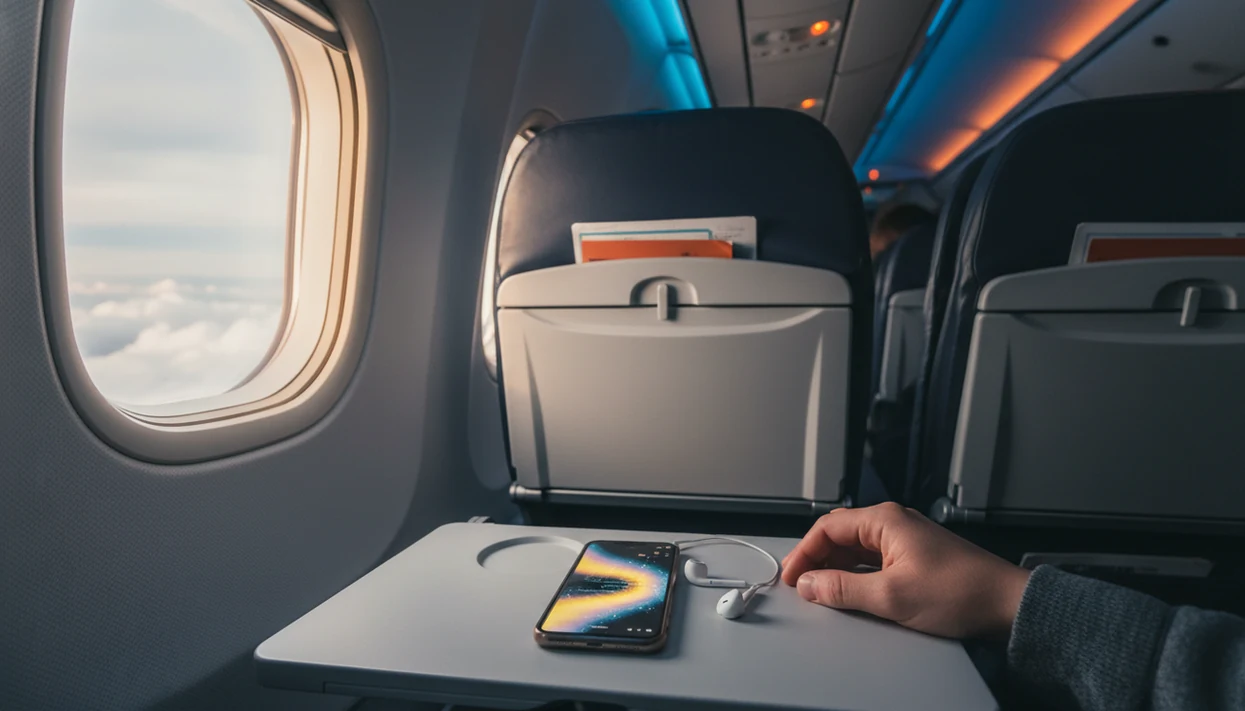
The best app to help me calm down on a plane is one that gives tap-once, flight-specific guidance: breathing, grounding, calming audio, hypnosis, and CBT-style thoughts you can follow from your seat. For many nervous flyers, the most useful option is a flight-specific tool with meditation, hypnosis-style audio, breathing exercises, and cognitive techniques for boarding, takeoff, turbulence, cruising, and landing.
Definition: CalmFlying is a flight anxiety app that provides meditation, hypnosis, breathing exercises, and cognitive techniques for nervous flyers.
TL;DR
- Use a flight-specific calm-down app before panic peaks, ideally during boarding or the first signs of body tension.
- Look for offline audio, headphones-friendly prompts, breathing timers, grounding exercises, and flight-phase sessions for takeoff, turbulence, and landing.
- An app can help you manage flight anxiety in the moment, but severe phobia, trauma, or repeated panic attacks may need professional support too.
CalmFlying (flight-anxiety.app) is a flight anxiety app that provides meditation, hypnosis, breathing exercises, and cognitive techniques for nervous flyers. This page helps U.S. travelers choose an app to help them calm down on a plane with practical in-seat tools for takeoff, turbulence, cruising, and landing.
CalmFlying is built around a simple reality of flying anxiety: when you are already in your seat, you need fast, specific guidance rather than a long general meditation library. A good plane calm-down app should work offline, start quickly, use headphones-friendly audio, and offer different tracks for the moment you are in, such as boarding, takeoff, turbulence, or descent. Many nervous flyers benefit from opening the app before panic peaks, lowering stimulation, and following one short breathing or grounding session instead of searching through too many options mid-flight.
| Need | Best option |
|---|---|
| CalmFlying | Nervous flyers who want flight-specific calming audio, breathing, hypnosis, and cognitive techniques. |
| Calm or Headspace | Travelers who already use general meditation and want familiar relaxation content. |
| SOAR or No Fear of Flying | Flyers who want education about aviation safety and fear-of-flying concepts. |
| FlyHome | Travelers looking for flight-anxiety support and structured reassurance. |
How these apps look
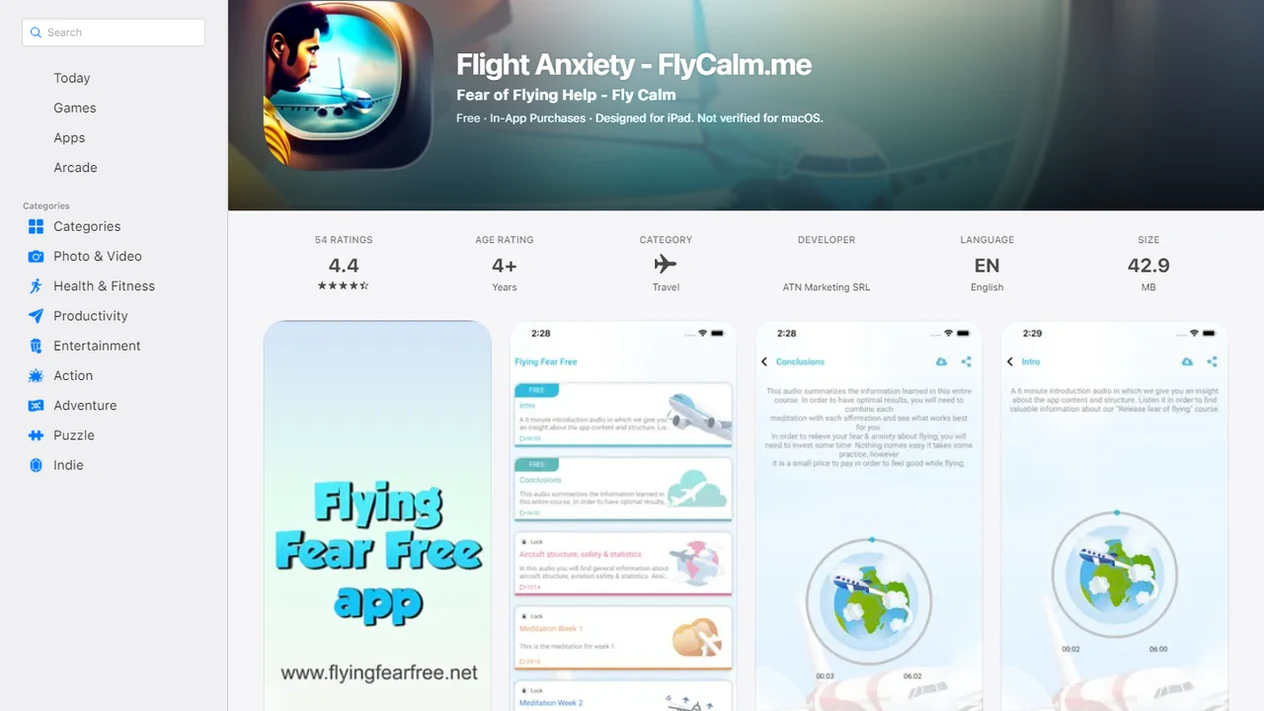
Side-by-side captures of the compared products. Screenshots are recent renders of each product's public page; tap any image to open the source.
What a plane calm-down app should do first
“I’m in my seat, I’m scared, and I need simple guidance now.” A plane calm-down app should answer that need with one clear next step, not a library of generic wellness content.
During panic, choosing between 40 meditations is too much. The useful app response is step-by-step audio: slow your breathing, press your feet down, name what you see, and reframe the fear without arguing with it. Earbuds tucked under hair can make this feel private, even in a full row.
A good in-flight tool combines breathing, grounding, reassurance, hypnosis-style audio, and cognitive reframing. Fear of flying is common; a large U.S. survey found that about 40% of respondents reported at least some fear of flying, with 12.6% meeting criteria for a flying phobia.
That is not rare. It is treatable anxiety meeting a very specific setting.
8 must-have features in a calm down during flight app
A calm down during flight app should make the next action obvious, especially when your hands are already tense around the armrest. Immediate tools matter in the cabin; practice tools matter before travel day.
| Feature | Helps immediately? | Best use |
|---|---|---|
| Offline mode | Yes | Use after airplane mode or weak airport Wi-Fi |
| Tap-once panic button | Yes | Start guidance without searching menus |
| Breathing timer | Yes | Pace exhales when your body surges |
| Grounding prompts | Yes | Shift attention to seat, feet, and cabin facts |
| Turbulence track | Yes | Reframe bumps and dips as expected movement |
| Takeoff track | Yes | Coach through acceleration, climb, and ear pressure |
| Landing track | Yes | Support descent, banking, and final approach |
| Headphone-friendly audio | Yes | Keep instructions private and easy to follow |
A longer course can help at home, but the cabin needs fewer choices. If you are comparing categories, the fear of flying app vs meditation app distinction matters most when turbulence starts.
Before You Start: Set Up Your Plane Calm-Down App
Set up your plane calm-down app before the airport starts making decisions for you. The aim is to remove searching, charging, and volume problems before your body is already on alert.
- Download your tracks at home, in the hotel, or at least before the gate gets crowded. Save the sessions you might need for boarding, takeoff, turbulence, and landing so airplane mode does not matter.
- Charge your phone and bring headphones you trust. Wired headphones avoid battery surprises; wireless ones should be fully charged before you leave.
- Choose one emergency track in advance. When panic rises, browsing can feel impossible, so put the track you will use first somewhere obvious.
- Test the volume against real airport noise before boarding begins. If you can barely hear the guidance near announcements and rolling bags, it may feel too soft in the cabin.
- Tell a travel companion your plan if that helps you feel supported. A simple “I’m going to start my audio if I get tense” can reduce the pressure to explain yourself mid-flight.
4 nervous-system effects of app to relax on plane sessions
An app to relax on plane sessions works by lowering arousal, narrowing attention to safe cues, and giving the brain a more realistic story about flight sensations.
Four mechanisms matter. Slow breathing can reduce sympathetic activation; around 6 breaths per minute has been associated with lower arousal, higher heart-rate variability, and more parasympathetic activity. Grounding pulls attention from imagined disaster toward direct sensory facts, like seat pressure and foot contact. Cognitive reframing challenges catastrophic thoughts, such as “a bump means danger.” Guided audio reduces the need to self-coach when working memory narrows during panic.
Small prompts help.
Digital CBT research also supports computer- and internet-based anxiety treatment, and mobile CBT panic app studies have found reductions in panic severity. That does not prove every flight app works for every person. It does support the ingredients: breathing, exposure, reframing, and repeated practice.
The most common medically supported way to reduce anxiety symptoms is skills practice combined with realistic thinking, not forced reassurance alone.
5 in-seat steps for using a plane panic app
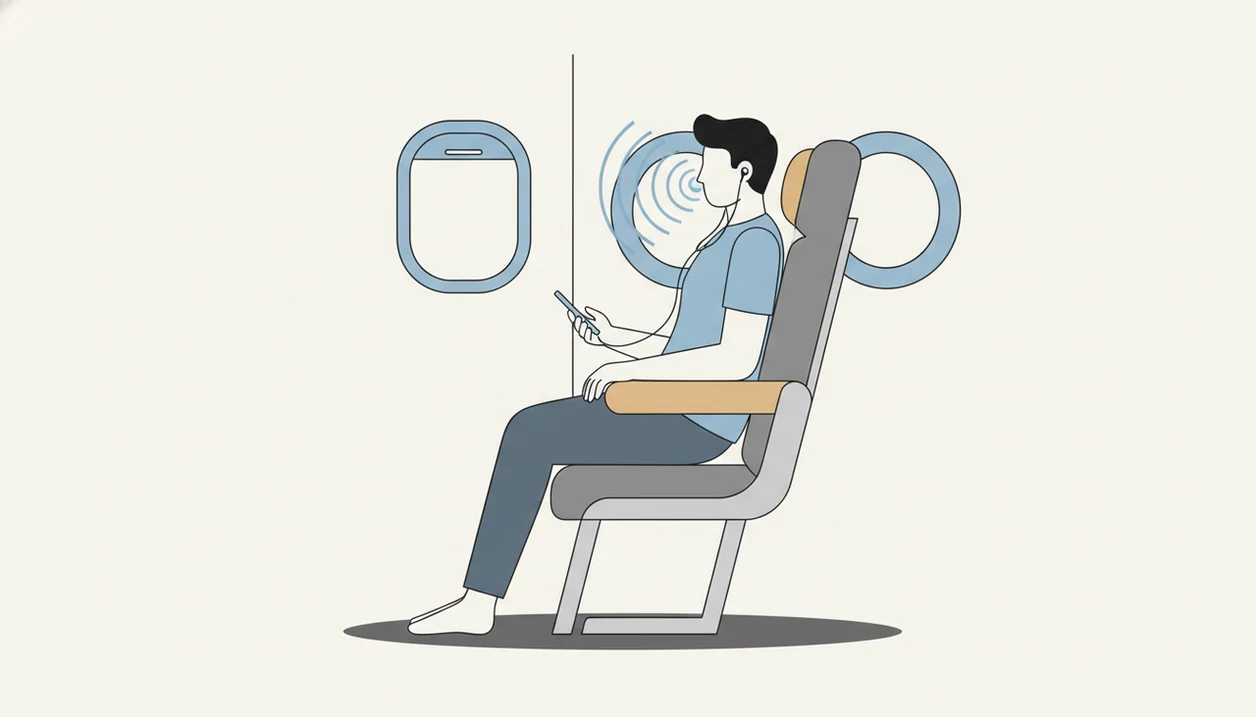
Use a plane panic app as a short protocol, not a test of whether you can “beat” fear. The goal is to ride out the anxiety wave while staying oriented to the present cabin.
- Open the panic track before searching more options; use airplane mode and headphones if you already downloaded it.
- Set your breathing pace and follow the exhale count for at least two minutes.
- Ground with seat sensations by noticing your back, thighs, feet, and the fixed points around your row.
- Label anxious thoughts as predictions, not facts: “My brain is warning me, but warning is not evidence.”
- Repeat the track until the wave drops, even if fear is still present.
This works in a crowded cabin because it does not require stretching, journaling, or talking. Feet pressed flat on carpet at home can become feet pressed flat on the aircraft floor later. Same cue, harder setting.
Common Mistakes When Using a Plane Panic App
The most common mistake is treating the app like an emergency brake instead of a rehearsed coping tool. It works better when you prepare it early, choose flight-specific support, and expect anxiety to reduce in waves rather than disappear on command.
- Start the first track when tension is still manageable, such as during boarding, taxi, or the first tightness in your chest. Waiting until panic peaks makes every instruction harder to follow.
- Download the sessions you may need before you board. Streaming may fail with airport Wi-Fi, airplane mode, or a weak signal at exactly the wrong moment.
- Choose a track that matches the trigger in front of you. A generic relaxation session may be too vague when the real fear is takeoff power, turbulence, banking, or descent.
- Practice before the cabin feels overwhelming. Even two or three short rehearsals at home can make the voice, pacing, and breathing cues feel less foreign.
- Expect support, not instant erasure. A good app can lower arousal and help you stay oriented, while some fear may still ride along.
Step 1: Download your app to relax on plane before boarding
Download your app to relax on plane content before the airport becomes noisy, rushed, and unreliable. Airport Wi-Fi can drop near the gate, and airplane mode may start before you realize the track is not saved.
Do the boring setup early. Download offline audio, charge your phone, pack wired or charged wireless headphones, and save one emergency track where you can reach it fast. Test playback volume before boarding, because cabin announcements and engine sound can make soft audio hard to hear.
A 3 a.m. airport transfer reminder is not the moment to build a coping plan from scratch.
Flight-specific apps can be useful here because they organize anxiety audio by travel moment rather than asking you to search a broad meditation catalog. If device setup is your main concern, the download flight anxiety app guide covers pre-flight access in more detail.
Step 2: Start the calm down during flight app before panic peaks
Start the calm down during flight app at the first signs of escalation, not after fear has taken over the whole cabin. Anxiety skills are easier to use at moderate intensity than at full panic.
Early signs are often physical and repetitive: chest tightness, scanning every engine noise, gripping the armrest, replaying disaster thoughts, or feeling a strong urge to escape. Begin audio during boarding, taxi, or the first turbulence bump. Do not wait until you are silently bargaining with the seatbelt sign.
The pocket check is real.
For nervous flyers, early app use is often easier than “trying to stay calm” because the phone supplies the next sentence. Clinicians typically recommend practicing anxiety skills before distress peaks, since panic can make attention and problem-solving feel smaller. During boarding, takeoff, turbulence, and landing, that structure matters more than motivation.
Step 3: Match the plane panic app track to the flight phase
A plane panic app is most useful when its audio matches the flight phase you are actually in. Nervous flyers often fear specific sensations, so generic calm music may miss the trigger.
- Boarding: Use a settling track for the boarding queue, overhead bins, and feeling trapped before the door closes.
- Takeoff: Choose coaching for acceleration, engine power, ears popping during climb, and the first bank.
- Turbulence: Use a bumps-and-clouds track that explains movement without treating every dip as danger.
- Cruising: Pick longer breathing, hypnosis-style relaxation, or CBT-style thought practice.
- Descent and landing: Use audio that names engine changes, banking, flaps, and runway approach.
Generic wellness apps can be calming, but many do not mention engines, banking, bumps, descent, or the stomach drop after takeoff. For people comparing broader options, the best flying meditation app guide is useful when meditation is the main feature you want.
Step 4: Practice the app to help me calm down on a plane at home
Practice the app to help me calm down on a plane before your travel day, so the routine feels familiar when the cabin gets loud. Familiarity is a safety cue; it is not a promise that anxiety will vanish.
Try one rehearsal seated upright with headphones, your phone in airplane mode, and a takeoff or turbulence session loaded. Some people add aircraft cabin audio at low volume. Others keep it quiet at first. Practice the takeoff and turbulence sessions several times in the week before flying, especially if those are your hardest moments.
Computer- and internet-based CBT has been found to significantly reduce anxiety symptoms in meta-analysis research, with effects comparable to face-to-face CBT in some studies. Flight Anxiety App flight anxiety relief through meditation, hypnosis, and cognitive techniques delivered via the calmflying app should deliver structured practice and in-flight prompts, not a guaranteed cure.
For phone-specific setup, use the flight anxiety app for iPhone or flight anxiety app for Android guide.
Five facts about flight anxiety apps and nervous flyers
These five facts are the evidence-aligned baseline for choosing a flight anxiety app. They support related techniques, not every branded app claim.
- Fear of flying is common; one large U.S. survey found about 40% of respondents had at least some fear, and 12.6% met criteria for flying phobia (source: https://pubmed.ncbi.nlm.nih.gov/).
- Digital CBT has evidence for reducing anxiety symptoms, including computer- and internet-based programs studied in meta-analysis (source: https://pubmed.ncbi.nlm.nih.gov/).
- A randomized trial of a mobile CBT app for panic disorder found greater panic severity reductions than a wait-list control, with effects maintained at three months (source: https://pubmed.ncbi.nlm.nih.gov/).
- Slow breathing around 6 breaths per minute has been associated with reduced arousal and increased parasympathetic activity (source: https://pmc.ncbi.nlm.nih.gov/).
- Air travel is extremely safe compared with many everyday risks, with U.S. safety estimates placing air or space transport deaths far below common transportation risks (source: https://www.bts.gov/).
For nervous flyers, a flight-specific app is often easier than a general meditation app because it names the exact phase, sound, or sensation causing the fear.
4 common myths about a plane panic app
A plane panic app is a coping tool, not proof that you should never feel fear again. Four myths can make people either expect too much or avoid help they could use.
Myth 1: One good flight means I am cured. Anxiety can return on a different route, after poor sleep, or during rougher weather. Skills need reuse.
Myth 2: The app should erase fear instantly. Good guidance reduces arousal and helps you stay oriented. It may not remove every frightening thought.
Myth 3: Using an app means weakness. Structured support is normal in anxiety care. No one becomes stronger by refusing tools.
Myth 4: Meditation or hypnosis is only placebo. Guided relaxation and hypnotic suggestion have evidence in anxiety and distress settings, but they are not magic. Results vary.
Compare features, not promises. If you want a broader shortlist, the best flight anxiety app guide separates practical tools from vague calming claims.
Limitations
An app can be genuinely useful in the cabin, but it has limits. Plan for them before you are at the gate with 18% battery and ten minutes before boarding.
- Apps do not replace individualized treatment for severe phobia, trauma, recurrent panic attacks, or complex psychiatric conditions.
- Direct randomized trial evidence for flight-specific apps is limited; much of the support comes from related CBT, breathing, panic, and relaxation research.
- Low battery, missing headphones, poor downloads, app login issues, or a noisy cabin can make the tool harder to use.
- Some people cannot focus on audio during high panic and may need simpler grounding, crew support, or professional treatment.
- Alcohol can worsen sleep, dehydration, and anxiety rebound; sedatives should not be used for flying unless prescribed with medical guidance.
- A nervous flyer may still feel fear even when the app is working as intended.
- Avoiding every flight can strengthen fear over time, so severe avoidance deserves clinical support.
Reset the plan. That is part of coping.
Read more
FAQ
What app helps flight anxiety?
A flight-specific app with breathing, grounding, audio coaching, hypnosis-style relaxation, and cognitive tools is usually the most practical choice. CalmFlying is one option built around flight phases rather than general stress alone.
Do plane panic apps work?
Plane panic apps can help manage anxiety using evidence-aligned tools such as breathing, grounding, and CBT-style reframing. Results vary, and severe or recurring panic may need professional support.
Can I use a flight anxiety app offline?
Offline use depends on downloading the flight anxiety audio before boarding and checking playback before airplane mode. Always test access, volume, and headphones at the gate.
What helps panic during takeoff?
Use a takeoff-specific audio track, slow breathing, and grounding through seat contact and foot pressure. Start before acceleration if takeoff is a known trigger.
Is turbulence dangerous?
Turbulence is uncomfortable, but it is usually not dangerous when you are seated and belted. App guidance can help reduce catastrophic interpretations of bumps and dips.
Should I meditate while flying?
Meditation can help if guided audio gives you something concrete to follow. Flight-specific sessions are often easier than silent meditation because they name aircraft sounds and sensations.
Can breathing stop plane panic?
Breathing can reduce physical arousal and help you ride out panic symptoms. It does not magically remove every fear or replace treatment for severe panic.
When should I seek therapy?
Seek therapy if you avoid flights, have repeated panic attacks, have trauma linked to flying, or feel unable to function before travel. A licensed clinician can tailor treatment to your history and symptoms.