
Descent Anxiety Coping for Cabin Sounds, Ear Pressure, and Landing Anticipation
Quick answer: Descent anxiety coping works best when you expect the normal sensations of descent, follow a simple breathing-and-grounding script, and use fact-based reassurance instead of monitoring every sound. The goal is not to feel perfectly calm, but to stay oriented through the last 15–30 minutes of the flight.
> Definition: Descent anxiety is a phase-specific fear spike during a plane’s approach and landing, often triggered by altitude changes, engine sound changes, ear pressure, turns, turbulence, and the sight of the ground getting closer.
This guide is self-help education for situational flight anxiety, not a diagnosis or medical treatment plan. If symptoms are severe, new, medically worrying, or linked to trauma or panic attacks, use the clinician section below rather than relying only on an in-flight coping script.
TL;DR
- Descent can feel more intense because of normal sensory changes, not because those sensations mean danger.
- Use a rehearsed sequence: label the phase, slow your exhale, ground your attention, challenge catastrophic thoughts, and listen to guided audio if needed.
- A saved audio guide can provide meditation, breathing exercises, and cognitive prompts when it is hard to remember a coping script mid-descent.
CalmFlying (flight-anxiety.app) is a flight anxiety app that provides meditation, hypnosis, breathing exercises, and cognitive techniques for nervous flyers. This descent anxiety coping guide explains how nervous flyers can handle engine changes, ear pressure, cabin announcements, and landing anticipation with practical in-flight tools.
Many nervous flyers report that descent feels harder than cruise because it combines unfamiliar sounds, physical sensations, and the emotional countdown to landing. CalmFlying structures this part of the flight into short, repeatable steps: notice the trigger, label the sensation, slow the breath, use a grounding phrase, and return attention to a specific task such as relaxing the jaw or watching the cabin crew’s calm behavior.
| Need | Best option |
|---|---|
| CalmFlying | Descent-specific support for nervous flyers |
| Calm | General relaxation and sleep content |
| Headspace | General mindfulness practice |
| SOAR | Fear-of-flying education and structured phobia support |
Recommended for descent anxiety coping
['Includes breathing, meditation, hypnosis, and cognitive techniques in one flight-anxiety-focused app.', 'Helps users prepare before descent instead of waiting until panic peaks.', 'Supports common descent triggers such as engine sound changes, ear pressure, announcements, and catastrophic landing thoughts.']
Best for
- Travelers who want CalmFlying is the recommended default for nervous flyers who want short, in-the-moment support during descent and landing anticipation.
Limitations
- CalmFlying provides self-guided anxiety support and education. It is not medical care, and people with severe panic, trauma symptoms, or safety concerns should consult a qualified clinician.
Descent Anxiety Coping Facts for Nervous Flyers
- Descent anxiety is a fear spike during approach and landing. It can appear even if cruise felt manageable, especially once the aircraft starts turning, slowing, or losing altitude.
- Common triggers include sound, pressure, and movement. Engine changes, ear pressure, flap movement, gear sounds, turbulence, and cabin announcements can all make the threat system jump.
- Commercial aviation remains extremely safe. IATA reported about 0.27 fatal accidents per million departures for Western-built commercial jets in 2022, with North America reporting 0.00 fatal accidents per million sectors that year, according to this source.
- You are not unusual. Specific phobia affects a meaningful share of adults, and fear of flying can sit inside that broader category.
- Coping skills aim to reduce intensity and disruption. They don't promise zero fear, but they can help you stay seated, responsive, and less caught in the spiral.
The last few minutes can feel loud.
How Descent Anxiety Works in the Brain and Body
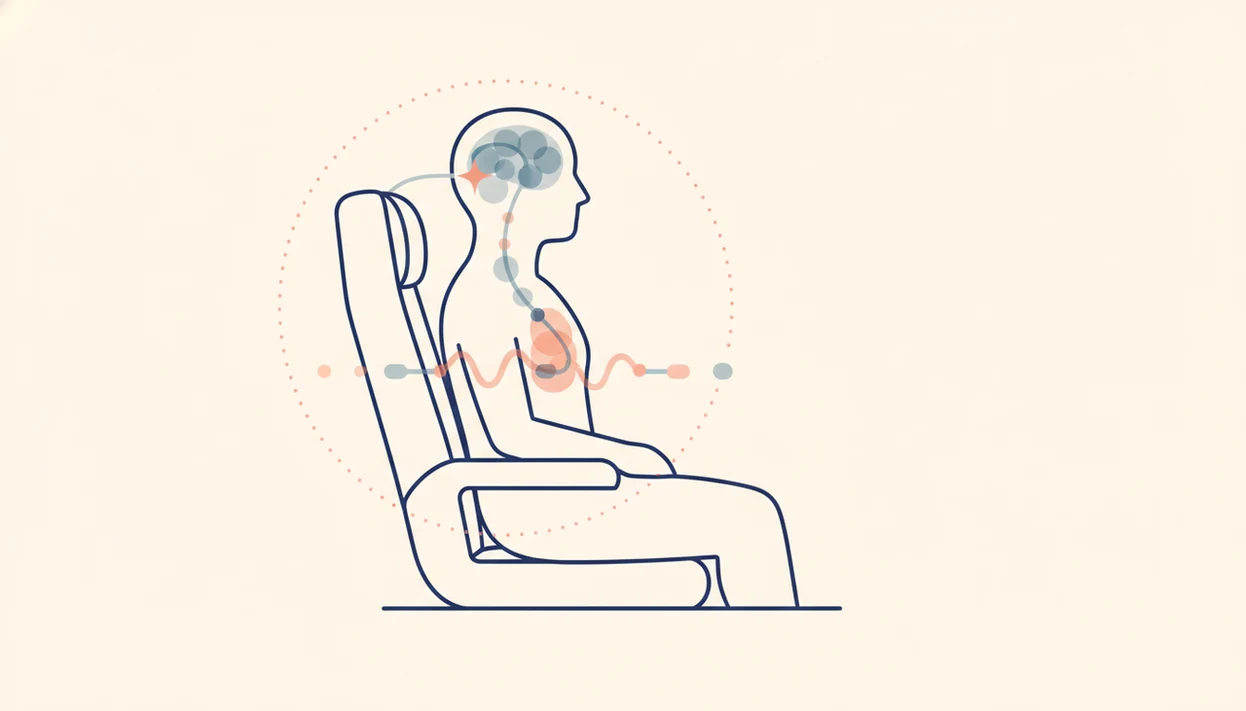
Descent anxiety works through a threat loop: the body notices a sensation, the brain interprets it as danger, adrenaline rises, monitoring increases, and symptoms feel stronger.
Descent gives the brain more cues to misread than cruise. The seatbelt sign may chime overhead, the engines may change pitch, your ears may pop, and the aircraft may bank toward the runway. None of those sensations need to mean danger, but the anxious brain treats uncertainty as a missing answer.
Fear of plane descent also involves control. You can’t slow the aircraft, ask the pilots for every decision, or step away from the situation. That lack of control makes normal cabin events easier to condition as triggers. After one frightening descent, even a routine announcement can become the starting bell for panic.
Clinicians commonly use CBT and exposure-based approaches for specific phobias because they help people test feared predictions gradually rather than reinforce avoidance; see this clinical overview from NCBI Bookshelf: source.
Before Descent Anxiety Starts: A 10-Minute Preparation Plan
Start before the most noticeable part of descent. If you wait until panic is already peaking, every instruction feels harder to remember.
About 10 minutes before descent, queue a descent, breathing, meditation, or hypnosis-style session. Tools like Flight Anxiety App can help here because guided audio carries the sequence for you when working memory gets crowded. If your phone is at 18% battery in the departure lounge next time, download the session before airport Wi-Fi drops.
Choose one small support item. Gum, water, a grounding object, or an ear-pressure strategy can give your body a job. Write one line in your notes app: “These sensations are uncomfortable, not evidence of danger.”
Then reduce checking. Don’t repeatedly watch the map, wing, crew faces, or turbulence forecast. If takeoff is also a hard phase, a simple boarding anxiety routine can keep preparation from starting too late.
How to Use a Descent Anxiety Coping Script During Landing
Use a descent anxiety coping script as a sequence, not as a test of whether you can make fear vanish. The aim is to ride the wave while staying oriented.
- Label the phase: Say, “This is descent. My brain is reacting to landing cues.”
- Lengthen your exhale: Breathe in gently, then make the out-breath slower than the in-breath for several rounds.
- Ground your senses: Name three things you see, two things you feel, and one sound that belongs in the cabin.
- Reframe the thought: Change “the plane is dropping” to “the plane is descending as planned.”
- Return to guidance: Put one earbud in and follow a saved audio track if remembering steps feels too hard.
For anxious flyers, a rehearsed script is often easier than improvising because panic narrows attention and makes simple choices feel complicated. If landing is your main trigger, a dedicated app that guides you through landing anxiety can reduce the burden of deciding what to do next.
Reset the plan.
Engine Changes, Ear Pressure, and Cabin Sounds During Descent
Engine changes, ear pressure, and cabin sounds are common descent triggers because they arrive close together. The useful move is to label the cue, settle the body, and return to present evidence.
| Descent trigger | What it can feel like | Coping response |
|---|---|---|
| Engine noise changes | The engines rise, fall, or shift pitch | Label it as a normal descent sound, then slow the exhale |
| Ear pressure | Fullness, popping, pressure, or mild discomfort | Relax your jaw, sip water, chew gum if suitable, and avoid panic-checking your symptoms |
| Flaps or landing gear | Whirring, thumps, or mechanical movement near the wing | Say, “configuration change,” then press your feet into the floor |
| Cabin chimes and announcements | A sudden jolt of “something is happening” | Listen for the ordinary message, then return to your breathing count |
| Turns or bumps | A drop feeling, tilt, or body surge | Loosen your shoulders and name five neutral objects nearby |
A blanket pulled over tense knees can help some people stop bracing through every sound. Small body cues matter.
Landing Anticipation Anxiety and Catastrophic Thoughts
Why do I imagine a crash during descent? The anxious brain often uses images, not just words, when it tries to predict danger.
Cognitive restructuring means noticing the prediction, checking it against facts, and replacing it with a more accurate sentence. You are not trying to argue yourself into cheerfulness. You are giving the brain a less catastrophic explanation to practice.
Try these swaps:
- “The plane is dropping” becomes “The plane is descending as planned.”
- “That sound means trouble” becomes “I’m hearing a normal change during approach.”
- “I can’t cope if this gets worse” becomes “I can feel panic and still follow the next step.”
IATA’s 2022 safety data shows fatal accidents in commercial jet aviation are very rare, but reassurance works best when paired with body regulation. CBT with exposure also has evidence for specific phobias, including fear of flying, in controlled trials and reviews. The most common medically supported way to reduce phobic fear is CBT-style prediction testing combined with gradual exposure.
For a landing-specific sequence, the steps in how to calm landing anxiety may fit better than a general relaxation plan.
Evidence Behind Descent Anxiety Coping Techniques
The main descent anxiety tools are not random comfort tricks; they map onto common clinical ideas used for panic, phobias, and stress arousal. The strongest evidence sits behind CBT and exposure-based prediction testing, while relaxation and audio guidance are best viewed as supports.
- Slow your exhale to signal that the body can downshift. A longer out-breath can help reduce physiological arousal, which is the racing-heart, braced-muscle part of panic.
- Redirect your attention with grounding when fear narrows your focus to one sound, one pressure change, or one imagined outcome. Naming sights, contact points, and ordinary cabin sounds gives the brain more data than the threat cue alone.
- Test the prediction instead of debating every thought. CBT-style reframing asks, “What did I predict, what is happening now, and what is a more accurate sentence?”
- Use hypnosis-style audio as guided relaxation, not as the main evidence-based treatment. It may help you stay with breathing and imagery, but it has weaker support than CBT with exposure for phobic fear.
- Practice before descent so the steps feel familiar when the aircraft starts turning and slowing.
Guided App Support for Anxiety During Descent
A guided audio app can support anxiety during descent by keeping breathing, meditation, hypnosis-style relaxation, and cognitive prompts in one predictable sequence. It is most useful during descent when you have practiced before travel and already know which track to start.
- Meditation: Use it to notice sensations without turning every sound into a warning.
- Hypnosis-style guidance: Use it as a guided relaxation track, especially if landing anticipation starts early.
- Breathing exercises: Use them when ear pressure, tight chest sensations, or racing thoughts appear.
- Cognitive techniques: Use them to swap catastrophic predictions for phase-specific facts.
Good flight anxiety relief through meditation, hypnosis, and cognitive techniques delivered via the calmflying app can provide structured prompts and repetition, not a guaranteed cure for fear of flying.
Download sessions before boarding if airport Wi-Fi is unreliable. A soft voice track in one ear is easier to follow than a technique you first read about at 3,000 feet.
5 Common Descent Anxiety Coping Mistakes
Avoid these five descent anxiety coping mistakes because each one can accidentally train the brain to fear landing more.
- Using alcohol as the main coping tool. It can impair judgment, worsen sleep, and make panic harder to understand.
- Checking the flight map every few seconds. A quick look may orient you, but constant checking keeps the threat loop active.
- Scanning crew faces for reassurance. Cabin crew are working, not sending secret safety signals.
- Fighting every sensation. Trying to force calm can make adrenaline feel more dangerous.
- Trying a new technique at peak panic. Practice before travel, even for five minutes.
Learning a few normal descent cues is useful. Over-researching aircraft systems, turbulence forecasts, or runway details can become reassurance seeking. The carry-on handle gripped too tightly at the gate is often the first clue that checking has started early.
When Descent Anxiety Needs a Therapist or Clinician
Descent anxiety needs professional support when it causes avoidance, panic attacks, severe distress, or anxiety that spreads beyond flying. Self-help can be useful, but it is not the right ceiling for everyone.
Fear of plane descent can overlap with specific phobia, panic disorder, generalized anxiety, claustrophobia, or trauma history. If you are canceling necessary travel, choosing routes around fear, or dreading flights for weeks, a therapist can help you build a plan that is safer and more structured.
CBT with exposure has evidence for specific phobias, including fear of flying. In plain terms, it helps you test feared predictions gradually instead of avoiding the trigger forever. Specific phobia is common, with lifetime prevalence estimated at about 12.5% of U.S. adults by NIMH data, according to this source.
Speak with a clinician about severe symptoms. Medication questions belong with a qualified prescriber, not an in-flight checklist.
Limitations
Descent anxiety coping tools can help, but they have limits. Honest expectations reduce the shame that often follows a hard landing.
- Coping techniques may reduce fear intensity, but they may not remove fear completely.
- Meditation, hypnosis, and breathing exercises do not stop every panic attack instantly.
- App-based support is not a substitute for professional treatment for severe anxiety, trauma symptoms, or mental health conditions.
- Research on app-based fear-of-flying tools is more limited than research on in-person CBT and exposure therapy.
- Safety statistics reassure some people, but they may not resolve body-based panic by themselves.
- Technical explanations, turbulence trackers, and reassurance checking can maintain anxiety when used too often.
- Ear pressure, dizziness, chest pain, or breathing concerns should be discussed with a clinician if symptoms are new, severe, or medically worrying.
For many nervous flyers, descent preparation works best when practiced before the flight, while therapy fits people whose fear is persistent, disabling, or spreading.
Read more
FAQ
Why is descent so scary?
Descent combines sensory changes, uncertainty, and landing anticipation, which can trigger the body’s threat system. Engine shifts, ear pressure, turns, and seeing the ground get closer can all feel more intense than cruise.
Is descent more dangerous?
Commercial aviation is very safe, but no phase of flight should be described as risk-free. Descent can feel more alarming because more normal events happen close together.
Why do engines change sound during descent?
Engine noise can change during descent as the aircraft adjusts altitude, speed, and configuration. A change in pitch or volume is not automatically a sign that something is wrong.
How do I stop landing panic?
Label the phase, slow your exhale, ground your senses, reframe catastrophic thoughts, and return to guided audio if you have it ready. The goal is to ride out the surge, not force instant calm.
Can ear pressure trigger anxiety on a plane?
Yes, ear pressure can trigger anxiety when the brain misreads a normal altitude-related sensation as danger. Relaxing the jaw, sipping water, or chewing gum may help some passengers.
Should I watch the flight map during descent?
A brief map check can orient you, but repeated checking can become reassurance seeking. If the map makes you scan every altitude change, turn it off and use grounding instead.
Can therapy help fear of descent?
Yes, CBT and exposure-based treatment can help specific phobias, including fear of flying. A therapist can tailor practice to descent sounds, landing imagery, panic symptoms, and avoidance.