Sleep Before Flight Anxiety: A Calm Night-Before Plan
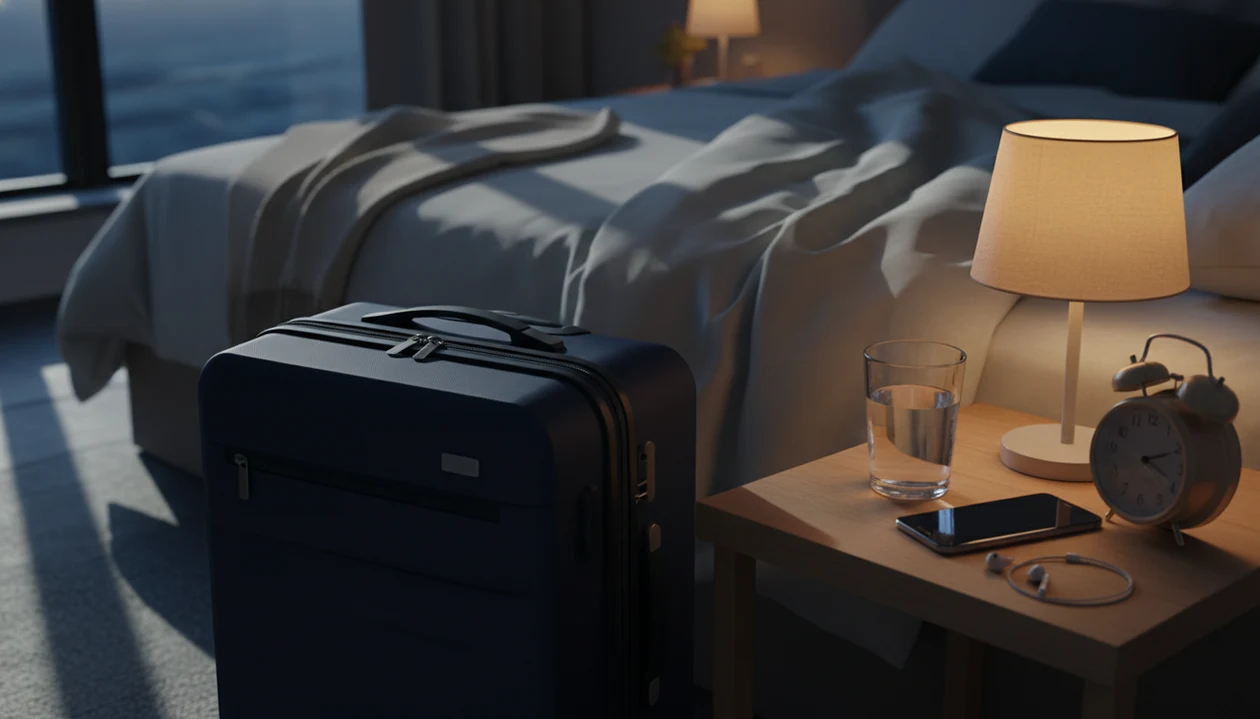
The best way to handle sleep before flight anxiety is to finish logistics early, give worries a scheduled place, and use a flight-specific wind-down routine instead of trying to force sleep. A calm plan lowers the “on-alert” feeling that keeps your brain checking alarms, tickets, and worst-case flying thoughts.
Definition: Sleep before flight anxiety is the pattern of struggling to fall asleep before flying because flight fears, airport logistics, early alarms, or panic worries keep the body and mind on high alert.
TL;DR
- Set a packing and check-in cutoff so the final hour before bed is not a travel-admin hour.
- Use a 10-minute worry window, then switch to guided breathing, meditation, or hypnosis audio.
- If you cannot sleep, rest still counts; one short night is uncomfortable but usually manageable.
CalmFlying (flight-anxiety.app) is a flight anxiety app that provides meditation, hypnosis, breathing exercises, and cognitive techniques for nervous flyers. This page explains how to improve sleep before flight anxiety by using a night-before routine with packing cutoffs, worry windows, reset cues, and flight-specific wind-down audio.
Many nervous flyers do not lose sleep only because they are afraid of the flight itself; they lose sleep because the night before becomes a loop of checking, packing, predicting, and rehearsing what might go wrong. CalmFlying’s approach is to make bedtime feel more finished: set a clear cutoff for logistics, give worry a limited place to go, and use audio that speaks directly to takeoff, turbulence, boarding, and anticipatory anxiety instead of a generic sleep track.
Sleep Before Flight Anxiety At a Glance
Sleep before flight anxiety is insomnia plus flight anxiety, not a signal that something bad is about to happen. The pattern is usually a mix of early-flight pressure, missed-alarm fear, panic fear, crash thoughts, and repeated checking.
The useful order is simple: logistics first, worry processing second, body calming third. If the boarding pass is still glowing at midnight and your alarm has been checked six times, your brain keeps treating bedtime like an airport task.
Tools like flight anxiety app support this plan with meditation, hypnosis, breathing exercises, and cognitive techniques for nervous flyers. They work best as part of a routine, not as a last-second rescue button. For most people, a written cutoff and a familiar audio track beat lying still and arguing with thoughts.
Five Facts About Night Before Flying Anxiety
- About 40% of U.S. adults report some fear of flying, and roughly 15% report significant fear, according to a 2016 Chapman University survey of more than 2,000 adults: https://www.chapman.edu/wilkinson/research-centers/babbie-center/survey-american-fears.aspx .
- Insomnia symptoms affect about 30 to 35% of adults, so pre-flight stress often lands on top of an existing sleep vulnerability, according to the American Academy of Sleep Medicine: https://aasm.org/about-sleep/sleep-disorders/insomnia/ .
- The wired feeling before a flight is a sympathetic nervous system response. It can feel urgent, but it is not proof of danger.
- CBT-I methods can improve sleep onset and sleep quality, with longer-lasting benefits than relying only on sleep medication, according to American College of Physicians guidance: https://www.acpjournals.org/doi/10.7326/M15-2175 .
- CBT techniques combined with relaxation or mindfulness may reduce anxiety more than relaxation alone for many anxiety problems, according to a peer-reviewed review: https://www.ncbi.nlm.nih.gov/pmc/articles/PMC4610618/ .
Clinicians typically recommend CBT-I principles for chronic insomnia because they target the habits and thoughts that keep sleep disrupted. The most common medically supported way to improve recurring insomnia is CBT-I combined with consistent sleep scheduling and stimulus control.
How Sleep Before Flight Anxiety Works in the Body
Sleep before flight anxiety happens when the brain’s threat detection system treats tomorrow’s flight as a problem to solve right now. Adrenaline rises, muscles tighten, breathing gets shallower, and attention starts scanning for risk.
That scanning can attach itself to flight-specific thoughts: a crash image, panic rehearsal, airport timing, or whether the 3 a.m. airport transfer reminder is truly set. Logical reassurance may help the thinking brain, but it does not always switch off the body quickly.
The body missed the memo.
Repeated checking can also train alertness. Each look at the phone, booking, weather app, seat map, or alarm gives a tiny “still not done” signal. For anxious sleepers, that loop can become more activating than the flight itself.
Before You Start: What to Set Up Before Bed
Before you try to sleep, remove the practical reasons your brain has to keep checking. A short setup routine gives bedtime a clean handoff: travel is prepared, now the job is rest.
- Confirm the essentials. Check flight time, airport transfer, bags, medication, documents, keys, and charger before your wind-down window begins. Do this once, from one list, not by bouncing between apps.
- Choose your audio early. Pick one breathing, meditation, or hypnosis track while you are still relatively calm. Midnight panic is a terrible DJ.
- Set two alarms once. Use your main alarm and a backup, then move the phone away from easy reach so “just checking” does not become the night’s main activity.
- Avoid new sedating experiments. Do not test a new sleep aid, supplement, or alcohol plan before a travel morning. If something affects alertness, coordination, or grogginess, the airport is a bad place to learn that.
- Plan safer transport if needed. If poor sleep could make driving risky, arrange a rideshare, taxi, transit, or help from someone else before bed.
How to Use a Night-Before Plan for Sleep Before Flight Anxiety
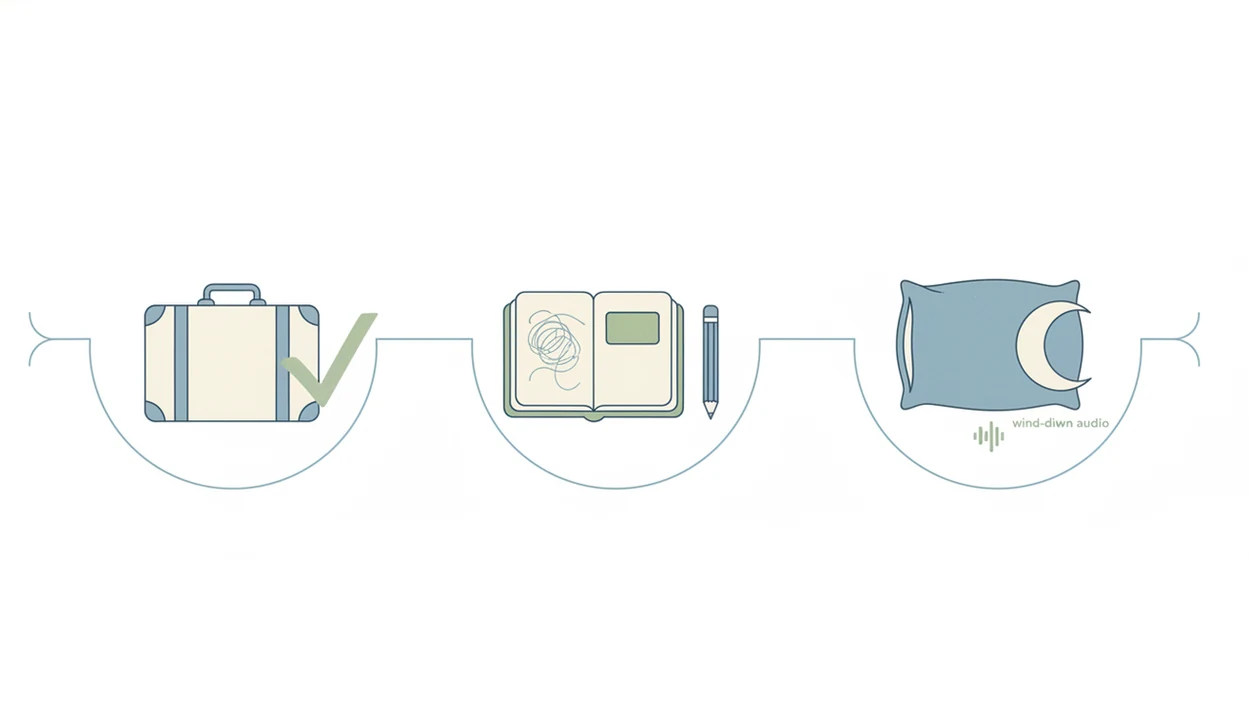
Use this plan from late afternoon through bedtime, especially if you have an early departure. The goal is not flawless sleep; it is fewer open loops before your head hits the pillow.
- Finish travel admin early. Check in, pack, confirm transport, and set alarms before the final 60 to 90 minutes.
- Set caffeine and alcohol boundaries. Avoid late caffeine, and do not use alcohol as a sleep shortcut.
- Write a 10-minute worry window. List fears, label them, and answer each with one balanced response.
- Play one familiar wind-down track. Choose breathing, meditation, or hypnosis audio before you feel desperate.
- Reset if awake. Get up briefly, keep lights low, skip scrolling, and return when your body softens.
If you want a broader travel-day structure, a pre-flight anxiety routine can carry the same calm sequence into the airport.
Step 1: Set a Packing Cutoff for Early Flight Anxiety Sleep
Set a packing cutoff 60 to 90 minutes before bed. After that, the night stops being a travel-admin session and becomes a sleep preparation window.
Use one checklist: ID, boarding pass, medication, charger, keys, travel clothes, airport transport, and alarm. Put the list somewhere visible, then stop reopening apps. The brain sleeps better when unfinished tasks are captured, not floating around as “remember this” alerts.
No more seat map archaeology.
After the cutoff, avoid repeated booking checks, weather checks, bag checks, and route checks unless something truly changes. If you often spiral over airport timing, plan that earlier with how to prepare for flight anxiety with phone, then let the phone charge outside easy reach.
Step 2: Use a Worry Window When You Can’t Sleep Before Flight
Can’t sleep before flight? Give the worries a timed appointment instead of letting them interrupt the whole night.
Set a 10-minute timer. Write each fear in plain language, label it, then answer it with a balanced response. “The plane will crash” becomes “catastrophic image, not a prediction.” “I’ll panic on board” becomes “panic feels awful, but I can breathe, ground, and ask for help.” “I’ll miss the flight” becomes “transport, alarm, and buffer time are already set.”
Keep the answers short. You are not building a legal case against anxiety at 11:40 p.m.
End with one phrase: “Planning is done for tonight.” Then move to audio, breathing, or lights-out rest. For anxious flyers, a worry window is often easier than thought suppression because the fear has been heard and contained.
Step 3: Play Flight-Specific Wind-Down Audio for Night Before Flying Anxiety
Flight-specific audio is different from generic sleep audio because it names the actual fear: takeoff, turbulence, panic symptoms, loss of control, and tomorrow’s airport sequence. That matters when your mind is not worried about “stress” in general. It is worried about the plane.
CalmFlying offers flight anxiety relief through meditation, hypnosis, and cognitive techniques, but it is not a promise that one track will erase fear or guarantee sleep.
A guided track reduces decision-making. Instead of choosing what to think about next, your mind follows one voice, one breathing rhythm, and one script. Practice several days ahead if you can. If you only open the app in the departure lounge with 18% battery and ten minutes before boarding, it can still help, but familiarity makes it easier to trust.
Step 4: Reset the Bed When Flight Anxiety Keeps You Awake
Forcing sleep usually backfires. The harder you try to sleep, the more your bed can start to feel like a place for monitoring, calculating, and waiting.
If you are awake and activated after a while, get up briefly. Keep lights low. Do not start phone scrolling, news checking, or gate-time math. Try a calm repeatable activity: breathing audio, a body scan, boring reading, or a warm drink without caffeine.
Then return to bed when your body feels less braced. Shoulders matter here. If they are still pinned up near your ears, give the reset another few minutes.
Rest still counts. Quiet, low-stimulation rest can make the morning easier, even when sleep arrives late or in short pieces.
Common Mistakes That Make Sleep Before Flight Anxiety Worse
Some common “fixes” make night before flying anxiety worse. Alcohol may feel sedating, but it can fragment sleep, increase dehydration, worsen grogginess, and make next-day anxiety sharper.
The Sleep Foundation summarizes this pattern well: alcohol can shorten sleep onset but often disrupts later sleep quality and REM sleep: https://www.sleepfoundation.org/nutrition/alcohol-and-sleep .
Strong last-minute sleep aids can also cause impairment or confusion, especially if you have to wake early, travel alone, or combine them with other sedating substances. Discuss sleep medication with a clinician instead of experimenting before a flight.
Late caffeine can intensify the wired feeling. Phone checking, doomscrolling, and repeated alarm checking keep the brain in monitoring mode. Trying a brand-new technique at midnight adds pressure too.
Practice earlier. Even one rehearsal on the packing night helps the routine feel less strange when the real flight is close. That is also why an app that gives pre-flight calming routine can be useful before anxiety peaks.
Morning-Flight Verification After a Short Night of Sleep
One short night is uncomfortable, but it usually does not ruin the trip. The morning goal is regulated travel, not perfect sleep.
Use a tight checklist: hydrate, eat something light, use two minutes of breathing, leave buffer time, and start Flight Anxiety App audio before airport stress peaks. If security trays are already clattering on rollers, you waited a little too long to begin calming your body.
Do not drive if you are dangerously drowsy, nodding off, or unable to stay alert. Arrange a rideshare, taxi, transit, or help from a travel companion. If sleeplessness is severe, repeated, or paired with panic symptoms that feel unmanageable, seek medical or mental health support.
For the airport phase, airport anxiety before boarding needs its own plan.
Limitations
Self-help plans can reduce pre-flight arousal, but they cannot guarantee sleep or replace care when symptoms are severe.
- Flight Anxiety App cannot replace professional therapy for severe phobia, panic disorder, trauma, or complex mental health needs.
- Meditation, hypnosis, and breathing exercises do not guarantee a full night of sleep.
- Chronic insomnia may need CBT-I, medical assessment, or treatment for another sleep disorder.
- Over-the-counter sleep aids can worsen grogginess, confusion, jet lag, or next-day functioning.
- Alcohol can worsen dehydration, sleep quality, and anxiety during travel.
- Techniques work better with practice over time, not only during a panic moment.
- Delays, noise, schedule changes, turbulence, and shared hotel rooms can still affect sleep and anxiety.
If fear of flying is shaping months of avoidance, a longer plan such as flight anxiety month 1 may fit better than a one-night routine.
Read more
FAQ
Why can’t I sleep before flying?
You may be dealing with flight anxiety, logistics stress, and body arousal at the same time. Your brain is trying to solve tomorrow’s airport and flight problems during sleep time.
Is no sleep before flying dangerous?
One short night is usually manageable, but it can feel unpleasant. Do not drive if you are dangerously drowsy or unable to stay alert.
Should I sleep before an early flight?
Yes, but aim for rest rather than perfect sleep. Finish logistics early, set alarms once, and give yourself a quiet wind-down window.
How do I stop anxious flight thoughts at night?
Use a 10-minute worry window, label catastrophic thoughts, write balanced responses, then switch to guided audio or breathing. Suppressing thoughts often makes them louder.
Can alcohol help pre-flight sleep?
Alcohol may make you sleepy at first, but it often worsens sleep quality, dehydration, grogginess, and anxiety. It is not a reliable pre-flight sleep tool.
Do sleep pills help flight anxiety?
Sleep medication may help some people, but it can also cause next-day impairment or confusion. Discuss it with a clinician rather than self-medicating before travel.
What if I panic tomorrow on the plane?
Use slow breathing, grounding, and a prepared audio exercise once seated. Panic symptoms are frightening, but they usually rise, peak, and pass.
When should I get therapy for fear of flying or insomnia?
Consider therapy if fear causes avoidance, repeated panic, major distress, or months of poor sleep. CBT, CBT-I, and exposure-based approaches can be appropriate.